An ethical decision-making algorithm tested in nine alarming scenarios in Grand Theft Auto V could reduce the potential loss of life by about 24%, researchers at Eastern Michigan University found. The game known for car chases and crashes is now a working lab for road safety.
Engineers at the University of Applied Sciences Osnabrück in Germany needed to try out wearable warning systems for hazards without exposing volunteers to road dangers.
The first device is attached to a bicycle’s handlebars and vibrates more intensely depending on the proximity of an approaching vehicle. The second one is a vibrating vest, designed to provide cyclists with a “sixth sense”.
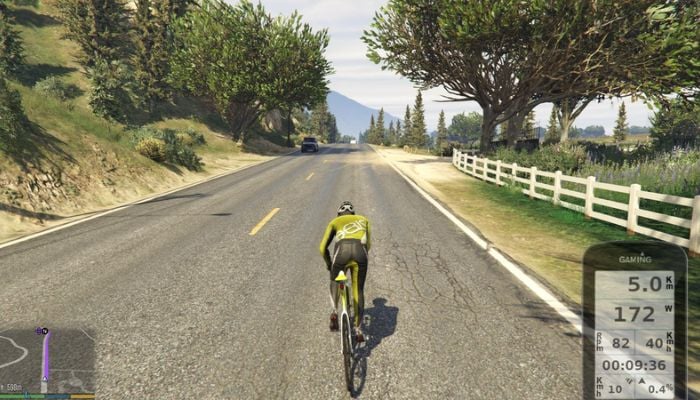
They hacked the game Grand Theft Auto V to enable them to control where the player starts and the specific scenario that unfolds. The participants rode on a stationary bike in front of the screen, which displayed the game environment Los Santos City, where trucks zoomed past.

At Delft University of Technology in the Netherlands, Pavlo Bazilinskyy and colleagues linked an eye tracker to GTA V. Their 2018 paper had 27 participants cycle through hazards such as a car leaving a parking spot and a door opening in front of them and concluded the game can yield useful data for human factors research.
Bazilinskyy claims that this budget makes the game way better than a regular simulator setup. It is supposed to be used for informing road designs and minimising the number of injuries.
The most widespread application of this game is training artificial intelligence to drive more safely. Researchers from the Korea Advanced Institute of Science and Technology created a large set of crashes that occurred in the game to train algorithms to recognise dangerous cars.
Another group uses the game to teach software how to move around busy roads without bumping into anything.
In the Eastern Michigan experiment, more difficult decisions were made, like swerving on the pavement to avoid a motorbike. 24% comes from simulations, and the entire sphere remains controversial.