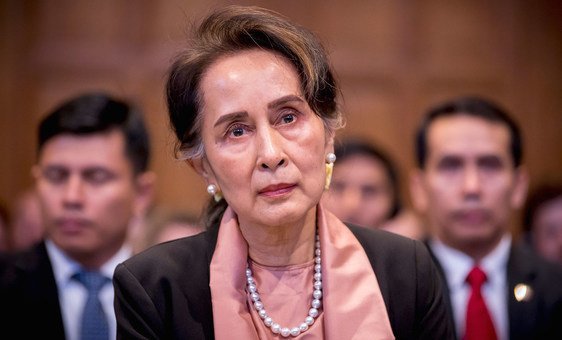
The UN Secretary-General took note of the move in a statement, reiterating his call for the swift and unconditional release of all those arbitrarily detained as a fundamental step towards essential political reform.
António Guterres believes that a viable political solution must be founded on an immediate end to the brutal civil conflict across Myanmar and a genuine commitment to inclusive dialogue.
Working towards peace
Sustained engagement by the military junta and rebel leaders with the UN Special Envoy for Myanmar is crucial to supporting efforts toward a peaceful resolution.
This includes coordination with regional partners such as the ASEAN group of nations, in line with calls from the Security Council and General Assembly.
Cambodia: Courts uphold conviction of former opposition leader Kem Sokha
And staying in Southeast Asia, UN High Commissioner for Human Rights Volker Türk has expressed deep concern over the top court’s decision in Cambodia to uphold the conviction of former opposition leader Kem Sokha, along with guilty verdicts against 33 other opposition figures, human rights defenders and social media users.
On Thursday, the Court of Appeals reaffirmed Sokha’s 27-year sentence on charges of treason, espionage and conspiracy, tied to a speech he delivered in Australia in 2013, four years before his 2017 arrest.
On Wednesday, in a separate case, the Court of First Instance imposed sentences ranging from 18 months suspended to two years in prison for 33 individuals.
They faced charges of “incitement to cause social chaos” over public comments they made in 2024 about the Cambodia-Laos-Vietnam Development Triangle Area project.
Human rights concerns
These recent convictions and sentences are inconsistent with international human rights law and risk deepening the chilling effects of broad, vaguely worded criminal laws and their arbitrary enforcement on civil society, journalists and the broader population in Cambodia.
Kem Sokha and the other 33 individuals were all exercising their rights to freedom of expression. Their trials raise concerns about violations of due process and fair trial rights.
The High Commissioner urges Cambodia to ensure that legitimate criticism and expression are protected rather than criminalised, to safeguard civic space, to guarantee the independence of the judiciary and uphold fair trial guarantees.
The authorities should quash these convictions and unconditionally release Kem Sokha and all others arbitrarily detained for exercising their rights. They should halt any further such prosecutions, and review Cambodia’s criminal legislation to ensure it is consistent with international human rights law standards.
New Israeli death penalty law ‘perpetuates racial discrimination’: Independent rights experts
The newly adopted ‘Death Penalty for Terrorists Law’ in Israel perpetuates racial discrimination against Palestinians, according to a panel of independent human rights experts on Thursday.
The UN Committee on the Elimination of Racial Discrimination – which is supported by the UN human rights office, OHCHR – said the new law amounts to a grave erosion of human rights, urging Israeli authorities to immediately repeal the legislation.
The Committee expressed alarm that the law mandates death by hanging as the default sentence for cases involving an ‘act of terrorism’ before Israeli military courts, which have exclusive jurisdiction over Palestinians in the Occupied Palestinian Territory – while Israeli citizens and residents are excluded from them.
The Committee said the new law is a severe blow to human rights, rolling back Israel’s long-standing de facto moratorium on executions since 1962 and expanding the use of the death penalty in Israel and the Occupied Palestinian Territory, including the West Bank and East Jerusalem.
‘Applicable to Palestinians only’
The Committee highlighted its concern that in Israel, “the law applies only to those convicted of deliberate killing with the intent of ‘denying the existence of the State of Israel’” making it in effect “applicable to Palestinians only.”
It further noted that the law prohibits mitigation, commutation or pardon of the death penalty and sets a 90-day deadline for executions once a final judgment is rendered.
Meanwhile, the Committee said the law was adopted amid escalating settler violence and unlawful killings with impunity across the Occupied Palestinian Territory, as well as ongoing, systematic violations of Palestinians’ due process and fair trial rights.
As of January 2026, 9,243 Palestinians were in Israeli custody, including 3,385 administrative detainees held without trial, according to UN figures.
A PAHO health worker prepares a rabies vaccination.
Critical inequalities in qualified health workers across South America
South American countries continue to experience significant healthcare inequalities when it comes to available workers in the sector reported in urban areas compared with rural and underserved communities, according to a new regional report by the UN-backed Pan American Health Organization (PAHO)
The report on Argentina, Bolivia, Brazil, Chile, Colombia, Ecuador, Paraguay, Peru, and Uruguay identified gaps that directly impact the availability of specialists and the ability of health systems to respond to the needs of the population.
These gaps included migration of health personnel, concentration in urban areas, misalignment between educational supply and the needs of health systems, and marked differences in working conditions between sectors and territories.
Investment needed
Among the findings, Brazil shows large inequalities, with lower availability in the north and northeast, and a high proportion of multiple contracts.
While Peru concentrates 85 per cent of personnel in urban areas and has an estimated shortage of more than 54,000 health workers.
“Countries need stronger information systems and comprehensive policies that simultaneously address the training, hiring, distribution, and retention of health personnel,” said James Fitzgerald, Director of Health Systems and Services at PAHO.
PAHO urges governments in the region to invest in training and policies to help retain workers, with special attention to primary care and areas with the greatest needs.