Qasr Al Watan Opens ‘Emirates of Pearls and Aromas: A Deep-Rooted Heritage and a Renewed Future’ Exhibition to Visitors
From the sea where pearls were born and the Aromas that travelled across continents, the story of the Emirates unfolds, from deep roots to a future without horizons.
Abu Dhabi(News Desk)::: Qasr Al Watan opens its doors to visitors to explore ‘Emirates of Pearls and Aromas: A Deep-Rooted Heritage and a Renewed Future’, an exhibition that offers a contemporary perspective on more than 7,000 years of Emirati history through pearls, oud and ambergris, and through the trade, crafts and practices associated with them that shaped an important part of the country’s economic, social and cultural life. In the collective memory of the Emirates, pearls are far more than gems brought up from the depths of the sea, and oud and ambergris are far more than treasures traded in the markets. Together, they tell the story of a nation that found its way to the world through the sea and drew on its limited resources to persevere, work and build. This heritage of pearls, oud and ambergris has always lived on in the bridges the Emirates built to the world and in the values that shaped our national identity.
The exhibition brings together rare objects, historical accounts and interactive and sensory features to take visitors on a journey that begins with ancient trade routes and people’s relationship with the sea and natural resources, and continues through the transformations that helped shape the modern United Arab Emirates. The exhibition presents heritage as a living legacy that can engage with the present and look ahead to the future, far more than a closed chest opened to retrieve a few memories.
Hosting the exhibition at Qasr Al Watan holds particular significance. As one of the United Arab Emirates’ foremost cultural landmarks, the palace embodies the country’s development, values and national identity. The exhibition extends the palace’s role in showcasing the UAE’s cultural, intellectual and architectural heritage and provides a platform for cultural dialogue at home and abroad and for introducing audiences to the authentic Emirati heritage associated with pearls, Aromas and other elements deeply rooted in the country’s cultural identity.
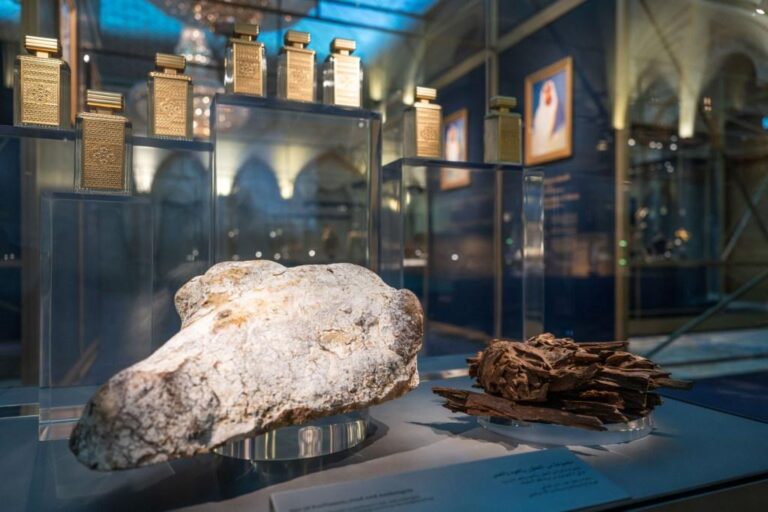
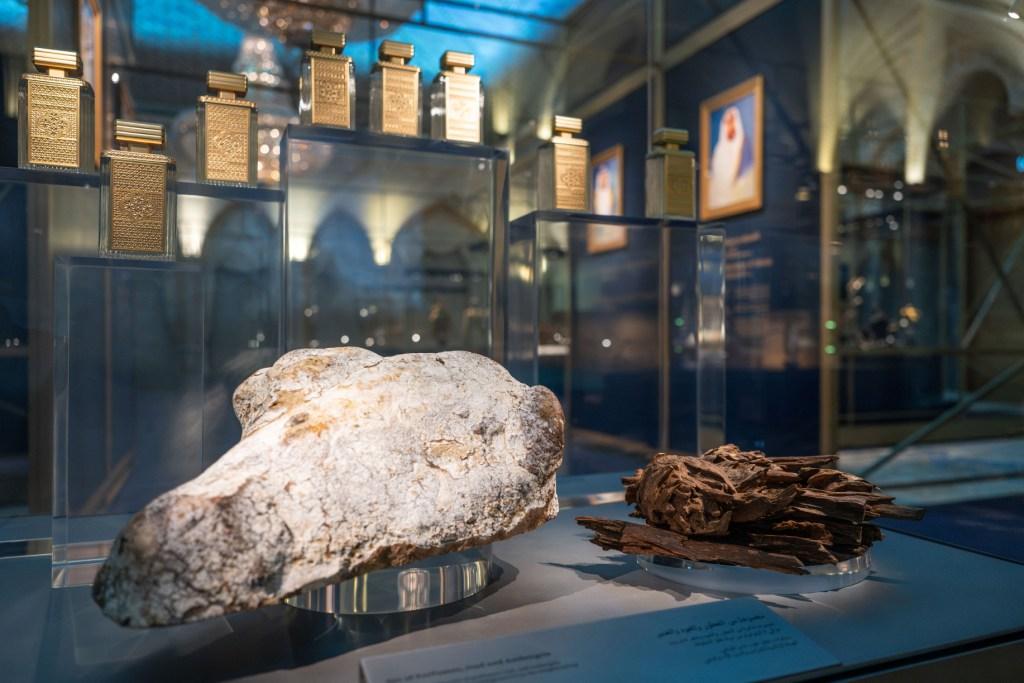
The exhibition features around 45 rare and valuable pieces. These include natural pearls, some dating to the Neolithic period and others to the first century BCE, as well as ‘Jaywan’, a perfectly round natural pearl distinguished by its purity and lustre, the ‘Al Tababah’ natural pearls weighing approximately five kilograms, and an artwork composed of 292 pearls from Ras Al Khaimah. Also on display are a pearl necklace given by the late Sheikh Rashid bin Saeed Al Maktoum to Pamela Codrai on the occasion of her wedding in 1952, a pendant bearing the likeness of the late Sheikh Zayed bin Sultan Al Nahyan, may he rest in peace, and a traditional gold bowl dating to 1988. The exhibition also features specimens of oud wood and natural ambergris, including a piece of ambergris weighing 28 kilograms. Behind every pearl lies a story that goes beyond its material value, a story of a diver, a dhow captain, a shipbuilder, a merchant, a craftsperson and a family waiting for a loved one to return from sea.
Among the highlights is the rare maritime ‘al-Ruznama’ from Ras Al Khaimah, which dates to the nineteenth and twentieth centuries and is on display for the first time. It records trading voyages and sailors’ observations, including references to Khor Fakkan and Ras Al Khaimah.
The visitor journey unfolds across three main sections. It begins with ‘Ancient Trade Routes: Pearls, Oud and Ambergris as Bridges to the World’, where visitors learn how the UAE’s strategic location connected ancient trade routes between East and West and how its coastline and historic ports helped trade and cultural exchange flourish over the centuries. More than a valuable commodity, pearls were the lifeblood of economic and social life in the pre-oil era. Pearling sustained an entire system of diving, shipbuilding, trade, crafts and maritime occupations. Shipbuilding itself was an economic force and supported a whole range of crafts and trades. These routes wove a network of commercial and cultural ties that made the Emirates’ shores a stopping point between East and West. Shipbuilding, diving and maritime trade were facets of a single story, showing that progress begins with people’s ability to turn what their environment provides into a livelihood, opportunities and a future, regardless of the abundance of resources. The exhibition also introduces visitors to diving seasons, maritime occupations, types of vessels and diving equipment, as well as the terminology used in sorting, grading, valuing and trading pearls.
The section ‘Nature: Treasures and Stories’ explores how pearls, oud and ambergris form in nature, their economic, geographical and cultural significance in Emirati society, and how these natural resources became part of everyday life, heritage and identity. The exhibition examines the place of oud and ambergris in Emirati social life and their association with hospitality, generosity and welcome, as well as their commercial value and their place in the trade in Eastern Aromas.
The exhibition concludes with ‘Pearls as a Historic Driver of Today’s Emirates’, which traces the country’s transition from an economy built on pearls and maritime trade to a modern economy driven by innovation, sustainability and technology. The story connects the roots of the past with the ambitions of the future. In a symbolic turn, the pearl inspired the name ‘Jaywan’ for a national payments system, creating a bridge between the heritage of the past and the UAE’s work today in artificial intelligence and innovation. This journey also encompasses the country’s move towards sustainability and clean energy, as well as the forward-looking vision embodied in the UAE Strategy for Artificial Intelligence 2031, which links the legacy of the past with the ambitions of the future. The UAE draws its resolve for the future from these values as it continues on its path with deep roots and boundless ambition.
The experience is complemented by interactive and sensory features, including screens, films, sound effects, maps and archival photographs, as well as devices that release the scents of oud and ambergris. The exhibition also features three contemporary artworks linking heritage with contemporary artistic expression. ‘Winds of Tradition’, inspired by the sails of traditional vessels, evokes the movement of merchant vessels across the Arabian Gulf. ‘Strings of Memory’ is a necklace made from natural pearls retrieved by divers. ‘Identity’ brings together Gulf pearls, oud, incense and ambergris. The exhibition speaks to several generations at once, allowing older visitors to relive memories whose details they know well and younger visitors to see how the prosperity and stability they enjoy today are deeply rooted in the experiences of their parents and grandparents.
Heritage that guides the way to the future lives on, and in the Emirates the sail stays raised even as the sea changes. ‘Emirates of Pearls and Aromas’ welcomes visitors to Qasr Al Watan every day of the week from 10:00 am to 5:00 pm, with last admission at 5:00 pm.