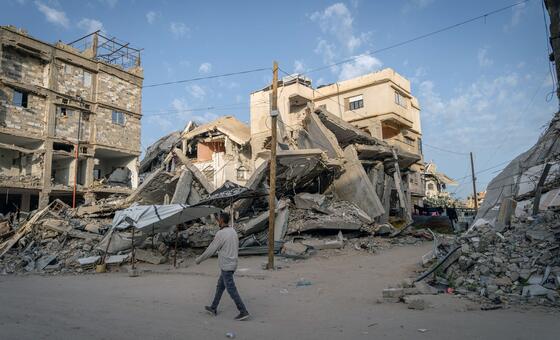
The latest UN humanitarian update on conditions in Gaza and the West Bank, released on 15 May, reports that most people in Gaza are displaced and exposed to health and environmental risks, while residential areas remain under attack.
Over 43,000 people in Gaza have sustained life‑changing injuries, the World Health Organization (WHO) estimates, while rehabilitation services remain overstretched.
Sorely needed aid supplies are trickling into Gaza: only one in every two aid trucks from Egypt could offload at Israeli-controlled crossings along Gaza’s perimeter in the first 11 days of May, based on data tracked by the UN-led logistics cluster, which coordinates deliveries.
However, despite the constraints, humanitarian partners are helping people in Gaza restore bread production and strengthen early market recovery.
Spike in settler violence
Civilian suffering is not confined to Gaza: the Jordan Valley has witnessed a spike in settler violence, with the monthly average of incidents causing casualties or property damage increasing 14-fold since 2020.
In the West Bank, 45 Palestinian-owned structures were demolished between 5 and 11 May. 90 per cent of the buildings were used for agricultural, livelihood, water or sanitation purposes.
Smoke rises in Beirut, Lebanon, following the outbreak of hostilities across the Middle East.
Lebanon: diplomacy overshadowed by ‘alarming’ reality on the ground
Despite the ceasefire that started on 17 April, civilians in Lebanon continue to endure an increasingly devastating toll from Israeli airstrikes, the senior UN official in Lebanon declared on Friday.
Imran Riza, the Resident and Humanitarian Coordinator in the country, noted that airstrikes and demolitions continue daily, causing civilian casualties among women, men and children, as well as displaced families, including Syrian and Palestinian refugees and Bangladeshi migrants. First responders have also been affected.
During his visit to southern suburbs of Beirut on Friday to assess the scale of destruction, Mr. Riza spoke to residents about their experiences of repeated displacement and trauma, lost homes and livelihoods, and damaged basic services.
“Residents shared devastating stories of loss, trauma and survival,” he said in social media post. “One man told us he was out on an errand when one of the strikes on 8 April destroyed his house, killing his wife, son and the two displaced families he was sheltering.”
Under international humanitarian law civilians – including humanitarian workers, medical teams and first responders – must be protected at all times, and the vital infrastructure civilians rely on must be spared. All parties must facilitate rapid and unimpeded humanitarian passage to civilians in need.
“Diplomatic efforts now offer a critical opportunity to stop the violence,” said Mr. Riza. “The people of Lebanon urgently need security, stability, and the chance to recover, not renewed pain, displacement, and suffering.”