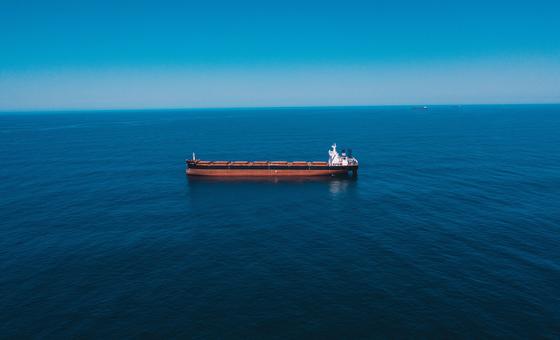
António Guterres decried the restrictions on free passage through the crucial chokepoint which is “impeding the delivery of oil, gas, fertilizer, and other critical commodities” and “strangling the global economy.”
Setting out three possible trajectories, he said that even if restrictions on shipping and trade were lifted immediately, “supply chains will take months to recover,” with global growth falling from 3.4 to 3.1 per cent, inflation rising to 4.4 per cent and trade slowing sharply.
“And a world still reeling from the shocks of a pandemic and the war in Ukraine will endure further economic distress. This is the best-case scenario,” he said.
UN problem-solving
Mr. Guterres highlighted diplomatic efforts underway by the head of UN Project Services (UNOPS) who is leading the UN Task Force on the strait to provide a possible humanitarian corridor.
The head of the UN maritime organization, IMO, is likewise developing a framework to evacuate ships and seafarers if safe passage can be guaranteed.
Devastating consequences
If disruptions arising from Iranian attacks and threats and the US blockade of Iranian ports continue through midyear, the consequences would deepen significantly, Mr. Guterres continued, updating correspondents in New York.
“Thirty-two million people pushed into poverty; fertilizers run low and crops yields fall; 45 million more people face extreme hunger; and hard-won development gains reversed overnight.”
In a worst-case scenario, where severe disruptions persist through the end of the year, “we confront the spectre of a global recession – with dramatic impacts on people, on the economy, and on political and social stability,” he warned.
Open the Strait now
“These consequences are not cumulative. They are exponential,” Mr. Guterres stressed, cautioning that “the longer this vital artery is choked, the harder it will be to reverse the damage.”
“My message to all parties is clear: Navigational rights and freedoms must be restored immediately … Open the Strait. Let all ships pass. Let the global economy breathe again.”
People wait in line with empty cooking gas cylinders in Kathmandu, Nepal. (file)
Economic shocks spreading
Against that backdrop, the economic shock is already being felt across global energy markets.
With no end in sight to the shipping stand-off in the Strait of Hormuz and as Brent crude oil prices hovered at around $118 in trading on Thursday, the prospect of running out of fuel, gas and more has focused attention in the world’s capitals on finding solutions, quickly.
Hormuz Strait closure sends oil and plastics prices soaring.
Southeast Asia and South Asia were first to be impacted by the most severe energy crisis in a generation, said Dario Liguti from the UN Economic Commission for Europe (ECE), but he warned that “it is an unfolding energy crisis,” with motorists in Europe already bracing themselves every time they fill up the tank.
Given how national economies the world over remain so dependent on fossil fuels and regional or geopolitical shocks, ECE has been bringing countries together in Geneva and elsewhere to discuss ways to wean themselves off fossil fuels, or at least use them more wisely.
Stop wasting fuel
One wasted resource that could be used far more widely is natural gas – methane – which is commonly burned off, or “flared” at oil wells, fossil fuel processing plants or refineries, as a safety measure.
Instead of burning off the gas – as is often the case at refineries the world over – it could be stored and used when needed, lowering our dependence on primary sources of energy, UNECE maintains.
The agency is already leading efforts to reduce emissions of methane which is more than 80 times more potent than CO₂ over a 20-year period and a clear driver of global warming.
Clean energy transition crucial
In line with sustainability goals which the world’s nations agreed to in 2015, the UN supports a transition to renewable energy production, away from fossil fuels.
The current crisis “is a clear signal that we need to advance with the energy transition in particular through the electrification of transport or heating,” Mr. Liguti stressed.
“We need to accelerate renewable energy deployment because these are decentralised energy sources and much cleaner, not only from an environmental perspective, but from an energy security perspective too.”