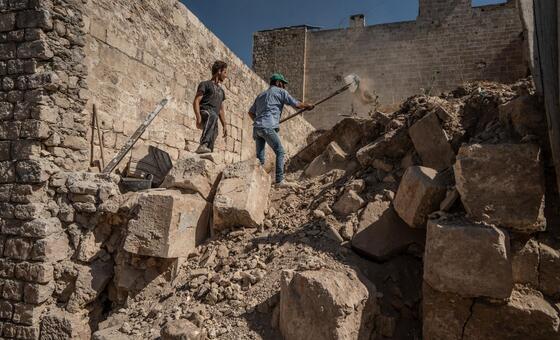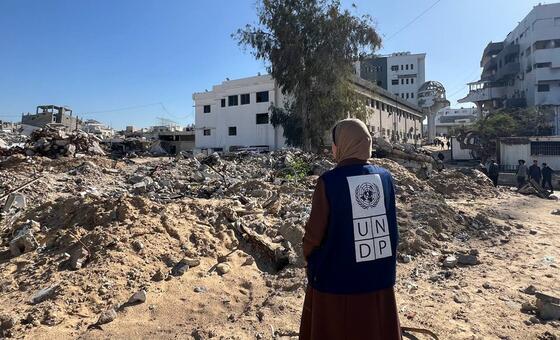
Across the Gaza Strip, vast piles of debris scar the landscape. More than two years of war between Hamas fighters and Israel have left the enclave covered with nearly 57 million tonnes of shattered concrete and other rubble.
With three quarters of Gaza’s built environment now destroyed, several reconstruction scenarios are under consideration. One of the most technically and politically sensitive options is to recycle debris to extend the enclave’s Mediterranean coastline and create artificial islands offshore.
Recycling constraints
This approach has the advantage of absorbing part of the enormous volume of war debris while reducing the need for dredging and the extraction of new materials for building use.
However, the UN Environment Programme (UNEP) cautioned that there is not enough rubble available for the massive engineering project.
The agency co-chairs the Debris Management Working Group which highlighted a reconstruction plan adopted by an extraordinary Arab summit in Cairo to restore 14 square kilometres (8.7 square miles) of land.
The project would require nearly 200 million cubic metres of aggregates but only around 10 million cubic metres of this can be sourced from recycled debris.
“Even if more than half (20 million cubic metres or approximately 55 per cent) of all debris generated in Gaza were recycled, it would still supply only about 10 per cent of the aggregate volumes required for reclamation projects of this scale,” the UNEP document noted.
The UNEP document stresses the need to assess such projects according to feasibility, cost and reconstruction priorities.
It says that recycled debris could be used to build artificial islands, or to backfill and raise low-lying land, provided the materials are clean and suitable from a geotechnical perspective.
Much of Gaza City has been destroyed in the conflict.
Building blocks
Under the scenarios reviewed, larger blocks could be used as foundations on the seabed, while recycled rubble could strengthen breakwaters and coastal defences. Finer materials could be used to raise land and reshape the coastline, with a requirement for new drainage systems.
But a central question remains: the nature of the debris itself. Gaza’s rubble contains a wide mix of materials from destroyed buildings. In addition to concrete, tiles, metals – including reinforced steel – that can be used again, many other elements cannot, from asbestos-containing sediment to furniture, not forgetting the human remains that have yet to be uncovered.
Given these complexities, UNEP insists that all non-recyclable and hazardous waste must be thoroughly sorted before it can be used.
Boosting recycling capacity
Meanwhile, UN teams are establishing two recycling centres in Gaza to turn rubble into construction materials. While concrete, brick, stone and tiles are relatively easy to process, UN experts are concerned about the possible presence of asbestos in collapsed roofing, as well as chemicals and industrial waste.
Unexploded ordnance poses another major risk, as it can contaminate soil or detonate accidentally, while progress remains dependent on the entry of heavy earth-moving equipment which remains restricted by Israel on security grounds.
Debris management also raises sensitive heritage and security issues. The rubble contains historical, archaeological, architectural and cultural sites destroyed during the war.
Lessons from Lebanon and Japan
Despite these constraints, several international precedents provide an indication of whether debris can be used in any Gaza reconstruction plan.
In Lebanon, after the civil war, Beirut used rubble to reclaim land from the sea, including around the Normandy landfill and the reconstructed city centre. But according to the UNEP document, that experience was marked by environmental and governance controversies.
In Japan, after the 2011 earthquake and tsunami, debris was extensively sorted and reused to protect the coastline, raise ground levels and support reconstruction. UNEP says that this shows how large-scale debris recycling is possible, provided strict technical and environmental controls are in place.
But such examples cannot be applied without robust legal and environmental safeguards.
According to UNEP, any use of debris in the marine environment must comply with Palestinian Environment Law No. 7 of 1999, which requires an environmental impact assessment for projects that may affect the ecosystem.
Beyond national legislation, the document recommends taking into account relevant international and regional frameworks for the Mediterranean, in order to identify good practices and address transboundary concerns.