He’s not alone, from Africa’s grasslands to the salt-crusted plains of Central Asia, this same story is playing out for millions of people who depend on land many people may never think about: Rangelands.
What are rangelands and why should we care?
Rangelands, which are found on every continent apart from Antarctica, are the grasslands, shrublands and drylands that don’t get farmed in the traditional sense, but nevertheless are a key part of the world’s food system.
- 2 billion people rely on them for food, livestock and livelihoods
- They supply nearly 70 per cent of the world’s livestock feed
- Yet up to 40 per cent are already degraded or at risk of vanishing, worn down by drought, overgrazing and years of being overlooked
Goats are sold at a market in Turkana in northern Kenya.
When a rangeland fails, it isn’t an abstract environmental loss. It’s a family’s herd with nothing to eat, a market with fewer animals to sell, a community’s food security unravelling in real time.
Three countries, one warning sign
Botswana
Rangelands cover much of this southern African country and underpin its economy, from beef exports to safari tourism.
But until a recent nationwide ecosystem assessment, there was no complete picture of their condition.
The findings were sobering: grasslands are shrinking as invasive plants spread and droughts hit harder and more often, leaving less time for the land to recover.
Rangelands cover a significant portion of Botswana’s land area.
Encouragingly, the assessment found that where traditional, community-led land governance is still strong, the rangelands hold up better, a reminder that local knowledge is a genuine asset, not a footnote.
Kazakhstan
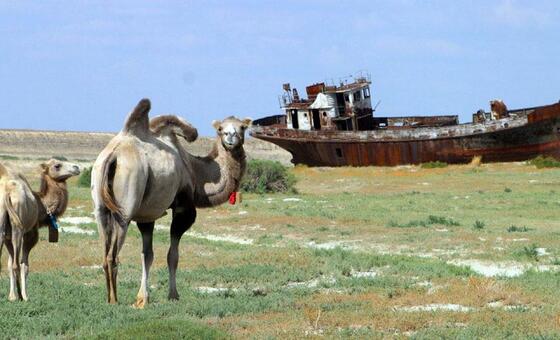
Once the world’s fourth-largest lake, the Aral Sea in Central Asia has largely vanished, leaving a 5.4-million-hectare salt desert behind.
In the neighbouring Kyzylorda region, over 80 per cent of pastures are now degraded, and toxic dust storms carry salt for thousands of kilometres.
It’s a stark example of how an environmental disaster in one place can poison land and livelihoods far beyond its borders.
Kenya
Marsabit County in northern Kenya is home to the Chalbi desert. Satellite records dating back to 1990 show grasslands steadily turning to barren ground, with the desert projected to double in size within decades if nothing changes, swallowing the pastures that generations of pastoralist communities have relied on.
What’s being done about it
Across all three countries, the response follows a similar, hopeful pattern: pairing hard data with the knowledge of the people who live on the land.
- Botswana built its national ecosystem assessment with more than 2,000 contributors, including government bodies, researchers and traditional knowledge holders, creating an evidence base to guide future land policy.
- Kazakhstan commissioned a detailed study of the links between climate, land and water, now shaping pasture restoration and irrigation plans, alongside a saxaul tree replanting programme on the dried seabed, already covering 337,000 hectares and aiming for 1.1 million by 2030.
- Kenya combined 33 years of satellite data with the memories of Indigenous elders who recall how the land used to look, feeding into practical fixes; a flood-diverting structure in Kalacha, test plots for regrowing vegetation, and training so communities can track changes themselves.
Rangeland is irrigated in northern Kenya’s Turkana region.
The takeaway
What connects these landscapes, thousands of miles apart, is a simple lesson: restoration sticks when people see their own knowledge and experience reflected in the solution. Data alone doesn’t save a rangeland; trust, ownership and lived expertise do.
For the herder still watching the sky, that combination might be the difference between a herd that survives and one that doesn’t.
On the road to Ulaanbaatar
The challenges rangelands face are due to be discussed at a UN desertification conference which is being held in Ulaanbaatar, Mongolia from 17 August.
The Biodiversity and Ecosystem Services Network (BES-Net) is one of the flagship initiatives of the UN Development Programme Nature Pledge, which focuses on strengthening efforts to protect and restore the Planet.