
The UN Educational, Scientific and Cultural Organization (UNESCO) announced the latest inscriptions to its Memory of the World Register on Thursday.
Submitted by 72 countries and four international organizations, they cover topics such as the scientific revolution, women’s contribution to history and major milestones of multilateralism such as the drafting of the Universal Declaration of Human Rights nearly 80 years ago.
Heritage at risk
The Register consists of documentary collections including books, manuscripts, maps, photographs, and sound or video recordings, which bear witness to the shared heritage of humanity.
These items often are extremely fragile and at risk of deterioration or exposure to disaster.
Collections are added by decision of UNESCO’s Executive Board, following the evaluation of nominations by an independent international advisory committee.
A map of human creation
Guilherme Canela, Director of UNESCO’s Division for Digital Inclusion and Policies and Digital Transformation, underlined the Register’s importance in an interview with UN News.
“If you want to understand the chemical composition of our planet, you consult the periodic tables of elements,” he said.
“If you want to have a diversified map of what human beings have created in the equally varied fields of literature, history and international relations, science, music, religion, philosophy, languages, cinema and many others, then you turn to UNESCO’s Memory of the World Register.”
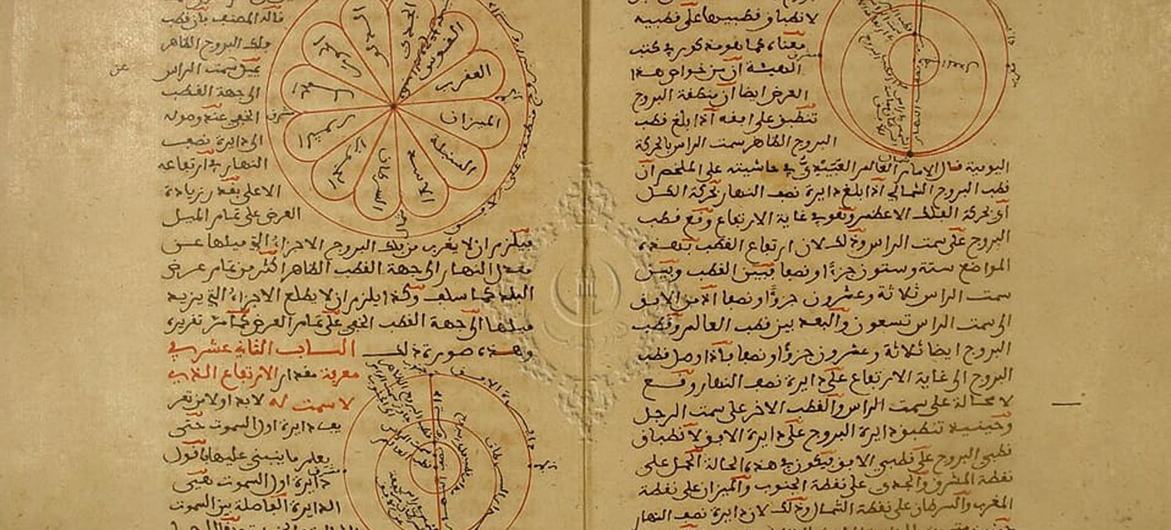
The Itḫāf Al-Mahbṻb documents the Arab world’s contributions to astronomy, planetary movement, celestial bodies, and astrological analysis during the first millennium of our era.
Diversity of contributions
Among the newly inscribed collections, 14 pertain to scientific documentary heritage, such as the Itḥāf Al-Mahbūb, submitted by Egypt.
The manuscript documents the Arab world’s contributions to astronomy, planetary movement, celestial bodies, and astrological analysis during the first millennium of the modern era.
The Darwin archives were submitted by the United Kingdom, while Germany provided the literary estate of philosopher, poet, and composer Friedrich Nietzsche as well as radiographs by Wilhelm Conrad Roentgen – the first recorded X-ray photographs.
Documents related to the memory of slavery have also been included, such as a census of slaves conducted by Portugal in its then overseas territories of Angola, Cabo Verde and Mozambique between 1856 and 1875.
The 79 slave registration books provide detailed records of enslaved Africans and freed persons, laying the groundwork for the abolition of slavery in 1869.
UNESCO noted that archives concerning prominent women are still largely missing from the Register. In this regard, Indonesia and the Netherlands together submitted letters by Raden Ajeng Kartini, a girls’ education pioneer.
Several collections document key moments in international cooperation, including the Geneva Conventions and their protocols – international treaties that aim to limit the brutality of war. Learn more about the Geneva Conventions in our explainer on international humanitarian law.
The Universal Declaration of Human Rights, proclaimed by the UN General Assembly in December 1948, and the 1991 Windhoek Declaration from Namibia – a global reference for press freedom – have also been added.