
“Four years ago, people in Europe woke up in another world because generations like mine have always had the privilege to live a life in peace,” Ms. Baerbock told journalists in Geneva. “But this changed four years ago with the full invasion [by] Russia, of the neighbouring country of Ukraine.”
Echoing the UN Secretary-General’s assessment that the ongoing war “is a stain on our collective consciousness”, UN aid officials emphasised the immense human and economic toll of the conflict, while also appealing to the world to “never get used to war”.
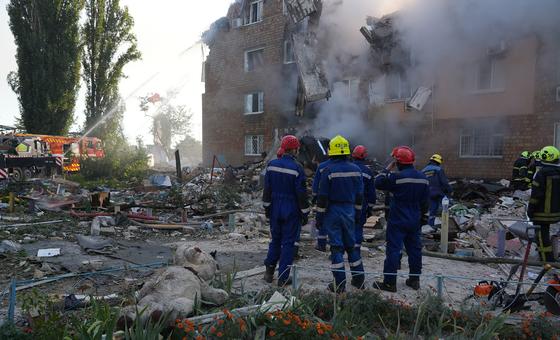
Reports on Tuesday indicated that Russian drone attacks injured at least five people in the frontline southeastern city of Zaporizhzhia, with apartment blocks and public facilities hit.
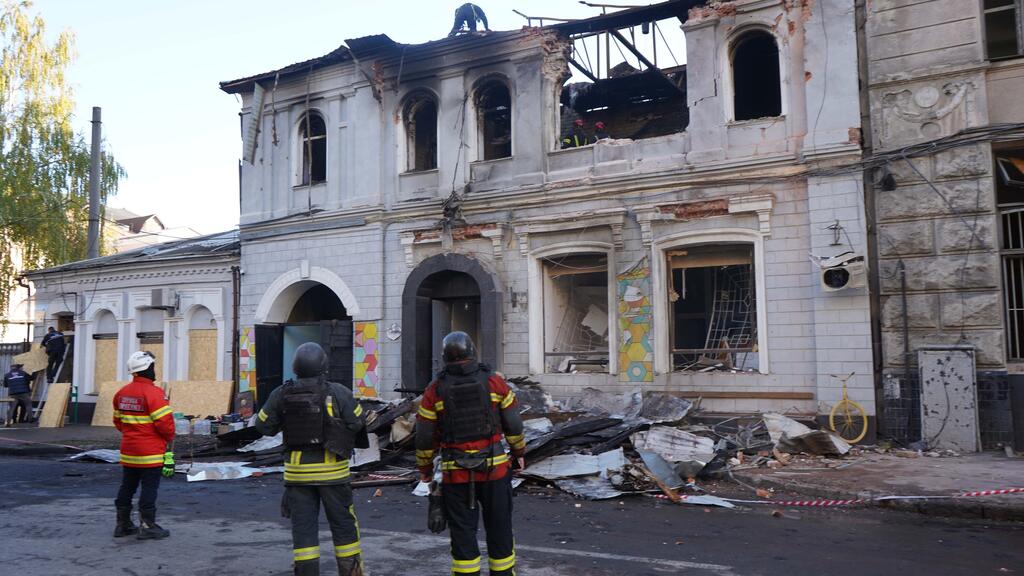
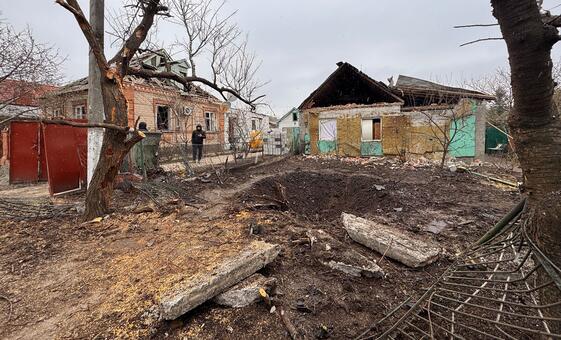
“We are witnessing the devastating impact of systematic attacks on energy infrastructure that have disrupted electricity, heating and water supplies across the country, in some cases leaving entire towns without electricity and water supply for weeks,” said Matthias Schmale, UN Resident and Humanitarian Coordinator in Ukraine, speaking from Kyiv.
Deadliest year
According to Mr. Schmale, 2025 was the deadliest year for civilians since the start of the full-scale invasion in 2022. Data shows that at least 2,500 civilians were killed and more 12,000 injured last year, a more than 30 per cent increase compared with 2024.
His comments came ahead of an emergency special session of the General Assembly due to take place in New York later on Tuesday.
Countries were expected to take action on a draft resolution including a ceasefire call and confidence-building measures such as the complete exchange of prisoners of war, the release of all unlawfully detained persons and the return of all internees and civilians forcibly transferred and deported, including children.
The UN Security Council was also due to meet over the ongoing war.
“This war needs to finally end… Any peace agreement must be grounded in the UN Charter, international law and General Assembly resolutions,” Ms. Baerbock said, highlighting the ever-present threat of death for civilians.
Killing time
“They told me count till 40 and if you’re still alive you obviously made it because with the rockets being shot over the border there is no time in many places to find a safer place,” Ms. Baerbock said, recounting the testimony of a teenage girl she met while visiting Kharkiv, 40 kilometres (25 miles) from Russian territory.
Calling on the international community to “work every day for peace” and amid reports of further peace talks between Russia, Ukraine and the United States in the Swiss city on Thursday, Ms. Baerbock reiterated the need for an “immediate, full and unconditional ceasefire” that respected the sovereignty, territorial integrity and independence of Ukraine.
Veterans’ challenge
Addressing the challenges which are part of the reconstruction and recovery process in Ukraine, Mr. Schmale said that there are up to one million veterans who need to be reintegrated into Ukrainian society, many of whom have suffered lifelong injuries, including amputations.
He also stressed that Ukraine is “among the most mined countries in the world”, with almost a quarter of its territory potentially contaminated by landmines.
Referring to a “rapid damage and needs report” launched on Monday by the UN in conjunction with the Ukrainian Government, the World Bank and the European Union, Mr. Schmale said that the estimated costs of recovery are “a staggering $590 billion over a 10-year horizon, which amounts to three times Ukraine’s GDP (gross domestic product) last year.”
What this kind of report fails to fully capture is “the destruction of the lives of human beings and their souls and mental well-being,” Mr. Schmale said.