
Soon after the fall of Bashar al-Assad in early December 2024, the international community began to ease sanctions against the country, in an attempt to improve the humanitarian situation and revive the battered economy.
The United States, United Kingdom and European lifted punitive measures covering around $15 billion in restricted assets and trade measures in May.
Regional powers including Saudi Arabia, Türkiye and Qatar have supported renewed engagement, offering to fund public salaries and energy infrastructure, and support Syria’s obligations to international financial institutions.
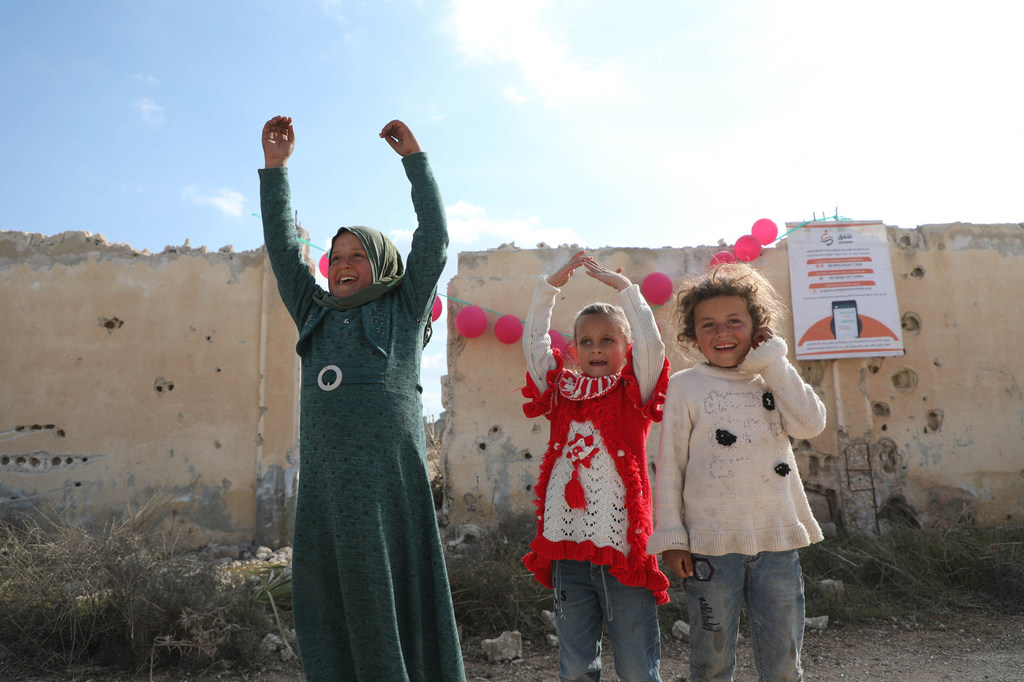
Syrian children welcome the arrival of a UN humanitarian mission (February 2025)
Bringing Syria back into the fold
Measures to bring Syria back into the fold were complicated, however, by the fact the group at the head of the offensive that removed Assad from power – Hayat Tahrir al-Sham (HTS) – had been proscribed as a terrorist organisation by the United Nations since 2014.
The leader of HTS under his nom de guerre Mohammed Al-Jolani was among those sanctioned, subjected to an asset freeze and travel ban – but now he serves as civilian leader of the Syrian Government under his real name, Ahmed al-Sharaa.
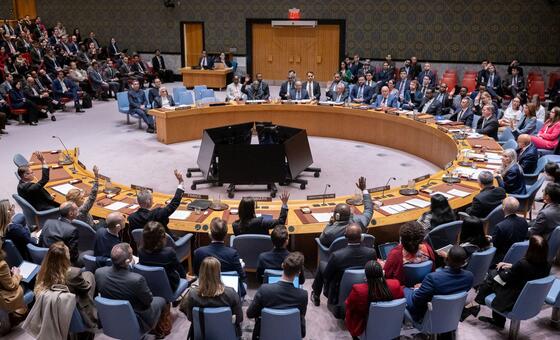
Thursday’s decision by the Security Council followed unilateral moves from several Member States. In July, the US revoked the designation of HTS as a foreign terrorist group, followed by the UK in October.
The Syrian president met his Russian counterpart Vladimir Putin the same month and is reportedly set to meet US President Donald Trump in Washington next week.
The US-sponsored resolution welcomes the interim government’s commitments to allow unhindered humanitarian access to the country, fight terrorism (including ISIL and Al-Qaida) and protect human rights. 14 Members of the Council voted in favour, and China abstained.
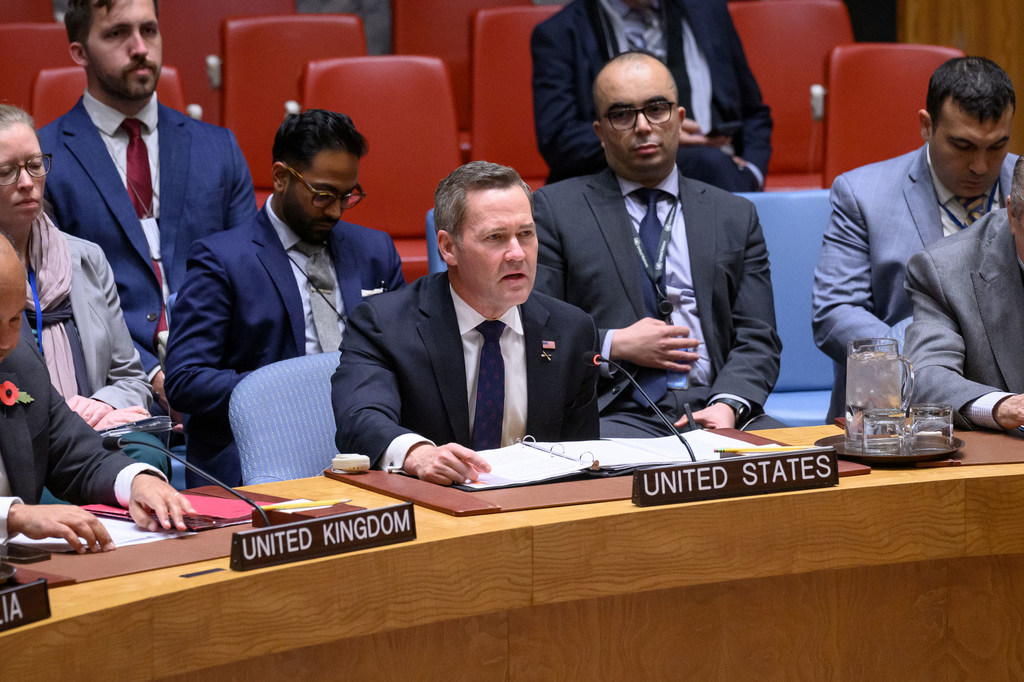
Ambassador Michael G. Waltz of the USA addresses the UN Security Council meeting on threats to international peace and security caused by terrorist acts.
‘A strong political signal’
Ambassador Mike Waltz of the United States described the resolution as a “strong political signal” that recognises that Syria is in a new era.
The government, he said, “is working hard to fulfill its commitments on countering terrorism and narcotics, on eliminating any remnants of chemical weapons, and promoting regional security and stability as well as an inclusive, Syrian-led and Syrian-owned political process.”
China abstains
China’s representative, Ambassador Fu Cong, explained his country’s abstention, declaring that whilst the resolution reaffirms the Council’s “counterterrorism requirements,” the United States “did not fully heed the views of all members and forced the Council to take action even when there were huge differences among Council members in an attempt to serve its own political agenda.”
“We welcome the delisting,” said James Kariuki, the UK Chargé d’Affaires, citing the progress made by the Syrian Government to date, including on advancing the political transition, and taking positive steps on counter terrorism and chemical weapons.
“We hope that this resolution will further encourage deeper engagement with the international community,” he added, “and support the Syrian people in their efforts towards reconstruction and economic development.”
Put Syria further on the road to recovery: Russia
Vassily Nebenzia, the Russian Permanent Representative, agreed on the need to facilitate Syria’s economic recovery and development during the transition period and said that the resolution reflects the interest and aspirations of the Syrian people. Mr. Nebenzia referred to Israel’s occupation of the Golan Heights and ongoing terrorist threats as factors which hinder long-term stability in the country.
The terror risk was also noted by Ambassador Jérôme Bonnafont of France, who said that “the fight against Da’esh (ISIL) in the Middle East is not over and the risks of a resurgence must not be underestimated.”
The adoption, he continued, is “an important step on the path towards the reconstruction of a sovereign united and reconciled Syria, one living in peace and free of the terrorist scourge.”
A ‘badge of honour’
Syria’s delegate, Ambassador Ibrahim Abdulmalik Olabi, welcomed the Council’s strong support and commitment to respecting the sovereignty and territorial integrity of his country. “We consider [this resolution] a sign of a growing confidence in the new Syria, its people and its leadership,” he said, describing it as a “badge of honour”.
Syria is turning the page on war and suffering, he stressed, building a modern State founded on the rule of law. “Damascus continues to extend its hand to all countries of the world,” said the Permanent Representative, adding that the government will strive to be a meeting point for East and West.