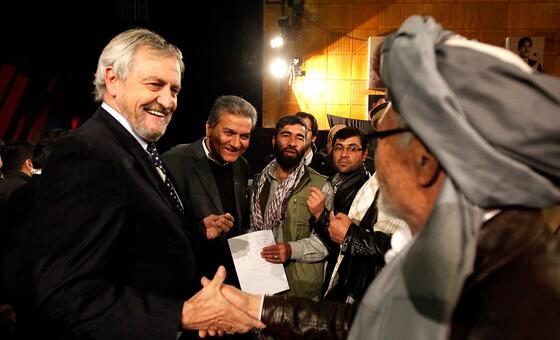


The informal meeting on the UN80 Initiative also provided a chance for ambassadors to share their views on the reform agenda, launched by Secretary-General António Guterres in March.
UN80 is centred around three workstreams focused on efficiencies and improvements, a mandate implementation review, and structural changes and programme realignments across the entire UN system.
Improving the UN
It also aims to reinforce the UN’s capacity to respond to global challenges such as conflict, displacement, and the climate crisis, while also managing external pressures effectively, such as shrinking budgets and growing political divisions.
“I think the UN80 Initiative is often characterised, but I think mischaracterised, simply as an exercise in downsizing in economy,” said Guy Ryder, Under-Secretary-General for Policy and chair of the Task Force overseeing the plan.
“But the Secretary-General has been rather clear in saying that whilst we have to respond to the resource situation, the overall intention of the Initiative is to strengthen and improve the workings of the UN system.”
Learn why UN80 matters to the world in our explainer here.
Widespread impact
Mr. Ryder alongside UN Controller Chandramouli Ramanathan (who prepares and oversees the budget and manages the Organization’s funds) presented updates on two workstreams during the morning session of the day-long meeting.
He set the scene with a slideshow outlining the background for UN80 and the circumstances confronting the UN today.
Over the years, the UN has adopted some 40,000 mandates delivered by “a fairly numerous and complex constellation of entities,” more than 140.
In 2023, the global body delivered some $69 billion in support and services worldwide, with “the lion’s share”, $31 billion or around 45 per cent, going to humanitarian action.
This was followed by development, $21 billion (30 per cent), peace and security, $9 billion (13 per cent), and human rights, $1 billion, or less than one per cent.
“We believe that the global population, in one manner or another…is connected to the global agenda of the United Nations,” he said. Additionally, some 440 million lives are directly impacted by its development work, and 140 million people in crisis situations receive support.
Reduction in resources
Mr. Ryder said the $69 billion mark two years ago represented “a peak” and it is estimated that the UN has some $50 billion in resources available today amid “a situation of significant uncertainty.”
This 30 per cent reduction means “we’re down to 380 million people who we’re able to reach directly in development work, and we’re down to 110 million as a reduction in emergency situations of our humanitarian spending.”
In light of this context, “maybe we can streamline the manner in which we implement the mandates that you hand down; maybe we can optimize the structures which form this archipelago of entities,” he suggested.
“The success of the UN80 Initiative depends on us being able to increase the impact that our work in the UN system has on the people who we are here to serve.”
Proposals to enhance efficiency
Mr. Ramanathan briefed delegates on workstream one. He said a working group was established to develop concrete proposals to enhance efficiency, reduce duplication, standardize services, and relocate functions to existing lower-cost duty stations where appropriate.
The “exhaustive list” of proposals could include measures such as consolidating existing human resources, finance and procurement services into unified support hubs. The process would start in New York and Geneva as they host the largest number of Secretariat entities and staff.
Another proposal involves having payroll operations centralized in three global processing centres, compared to 10 locations today.
The working group is finalising the proposals to be submitted to the Secretary-General and “if approved, they will be incorporated into the revised estimates for the 2026 proposed programme budget for the consideration of the General Assembly by 1 September,” said Mr. Ramanathan.
“Separately from the UN80 Initiative, we are reviewing the programme budget proposals for 2026 with a view to achieving between 15 and 20 per cent reductions for 2026, including a 20 per cent reduction in work force, post reduction, but with a focus on preserving capacity at entry levels and reducing senior posts where feasible,” he added.
A ‘universe of mandates’
Mr. Ryder returned to present workstream two, where the first step involved mapping out “the universe of mandates” that the UN implements, with initial focus on Secretariat departments and offices, peacekeeping operations, political missions, regional commissions and other bodies.
The Pact for the Future and the 2030 Agenda for Sustainable Development were among the most frequently cited mandates.
The overall “landscape” of mandates means that the Secretariat services some 400 intergovernmental organs and roughly 27,000 meetings each year and processes some 2,300 pages of documentation on average every day, amounting to around $360 million annually.
A mandate resource registry has been produced, and a report should be available by the end of July which will inform the way forward.
Concern over proposed budget cuts
During the session, several representatives expressed their views on UN80, such as Iraqi Ambassador Dr. Abbas Kadhom Obaid, who spoke on behalf of the Group of 77 and China.
He voiced concern over the proposed 15 to 20 per cent budget reductions, and the 20 per cent staff reduction, requesting more insight into how these figures were determined.
“This is important since we know that the departments, divisions, in the Organization’s funds, programmes and agencies vary greatly,” he said.
“We must also protect the geographical and gender balance in the context of any downsizing. As the Group has reiterated several times, the matters of transparency, accountability and inclusivity are paramount during this process.”
Fit for the future
The meeting took place just days before the 80th anniversary of the signing of the UN Charter on 26 June 1945, as General Assembly President Philémon Yang noted in his opening remarks.
He said it was a time to “reflect on the last 80 years and all that this Organization has achieved, and also a time to look to the future,” so the UN can remain fit for purpose – and ready for the next 80 years.