
Mr. Trump chaired the summit-level meeting of the 15-member Council, initiated by the US, to discuss ways that the body overseeing global peace and security can better enforce resolutions concerning the non-proliferation of weapons of mass destruction.
Top of the President’s concerns after laying out the “urgent importance” of countering nuclear, biological and chemical weapons use everywhere, was the JCPOA, commonly known as the Iran nuclear deal.
The JCPOA – reached by Iran, China, France, Germany, Russia, the United Kingdom, the US and the European Union – sets out rigorous mechanisms for monitoring restrictions placed on Iran’s nuclear programme, while paving the way for the lifting of UN sanctions against the country.
“This horrible, one-sided deal allowed Iran to continue its path towards a bomb,” he declared. From November, he said, US sanctions would be in “full force” and the White House would impose further measures. Anyone failing to comply with the US “would face severe consequences,” he warned.
‘The world is watching’ Idlib
Turning to the fate of millions of Syrian civilians effectively trapped in Idlib, Mr. Trump thanked the Syrian, Russian and Iranian Governments for turning away from a full-scale assault earlier in September.
“I hope that the restraint continues. The world is watching,” he said, also thanking Turkey for its role in brokering a civilian buffer zone.
Straying from the main topic of the meeting, President Trump said that the US had “found that China has been attempting to interfere in our upcoming 2018 election…They do not want me, or us to win, because I am the first President ever to challenge China on trade,” he asserted, without offering further clarification.
In his remarks, Chinese Foreign Minister Wang Yi categorically denied any involvement, asserting that “China has all along followed the principle of non-interference in other countries domestic affairs. This is a tradition of Chinese foreign policy.” He added that China “refused to accept any unwarranted accusations.” Mr. Yang also described the JCPOA as a “hard-won achievement of multilateralism,” and a “viable agreement” that Iran was honouring.
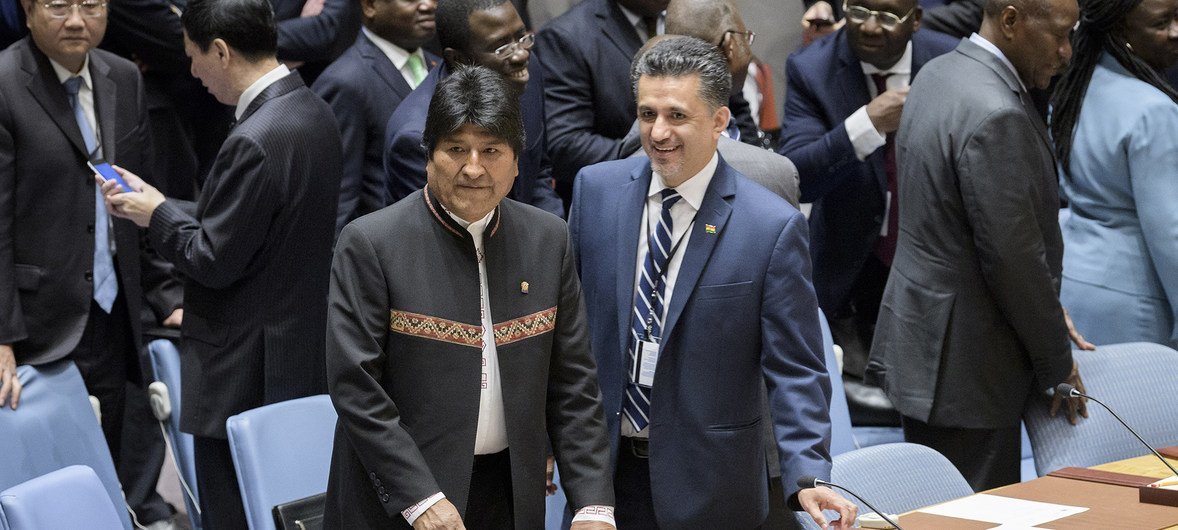
Evo Morales Ayma (left), President of the Plurinational State of Bolivia, and Sacha Sergio Llorenty Soliz, Permanent Representative of Bolivia to the United Nations, await the start of the Security Council meeting on the maintenance of international peace and security, with a focus on non-proliferation of weapons of mass destruction.
‘Contempt’ for multilateralism
Speaking soon after the US leader, Bolivian President Evo Morales painted a very different picture of the world’s power dynamics and the role of the US. Iran, he said, was “once again, the victim of a US siege” following America’s withdrawal from the JCPOA.
He said the US was “hiding behind pretexts, to continue its policy of interference and meddling” in Iran. He said the people of the Middle East had suffered “illegal invasion” in Iraq, the unjust overthrow of the Government in Libya in 2011, and a disastrous civil war in Syria – all the result of Western meddling.
He accused the White House of “contempt for international law, for multilateralism, and for the purposes and principles of the Charter of the United Nations.”
The Prime Minister of the United Kingdom, Theresa May, said the Permanent Members of the Council had a “special responsibility to protect the significant gains” made on stopping the use and stockpiling of nuclear, biological and chemical weapons.
But after chemical weapons had been used repeatedly and with impunity in Syria, as well as isolated attacks in Malaysia and in the English city of Salisbury – allegedly targeted assassinations – she said that decades of progress were now under threat.
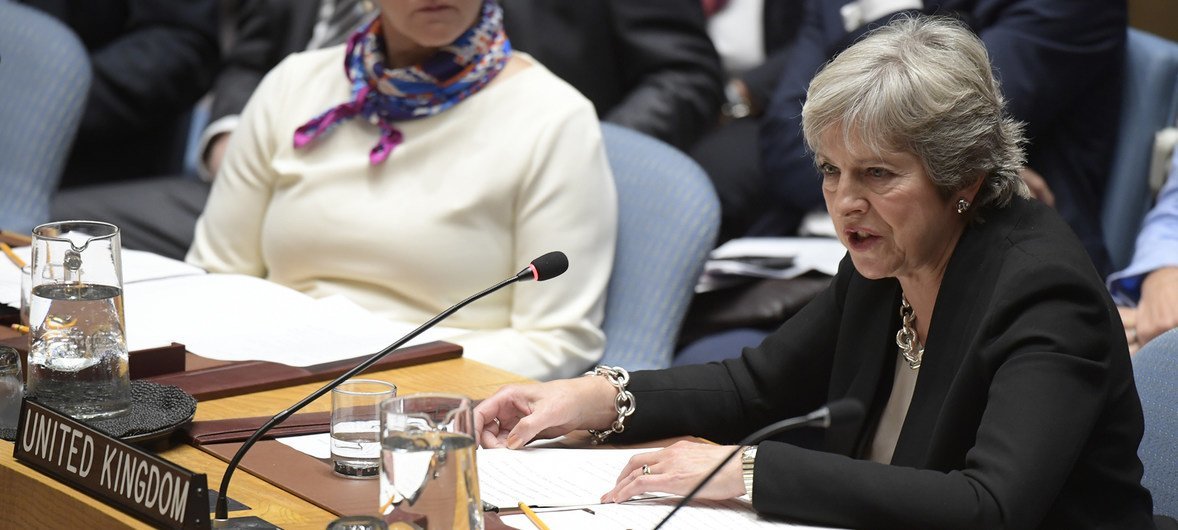
Teresa May, Prime Minister of the United Kingdom of Great Britain and Northern Ireland, addresses the Security Council meeting on the maintenance of international peace and security, with a focus on non-proliferation of weapons of mass destruction. At her right Margot Wallström, Minister for Foreign Affairs of Sweden.
Progress stopping chemical, biological warfare could ‘fall away’
“Predictability and stability are declining. If we do not increase our collective efforts to preserve and build on what we have, there is a very real risk these gains will subside or fall away.”
She praised President Trump’s efforts in détente over DPRK, commonly known as North Korea, but called for sustained pressure and strict enforcement of sanctions. On the JCPOA, she said that “it remains the best means of preventing Iran developing a nuclear weapon, and we are committed to preserving the JCPOA as long as Iran continues to abide by its obligations in full.” She offered “strong support” to the International Atomic Energy Authority (IAEA) for its verification and monitoring role inside Iran.
On the Syrian Government’s verified use of chemical weapons during the ongoing conflict, Ms. May praised US and French action with the UK, to respond militarily earlier this year following attacks. She said it “sent a clear message” to the Assad regime. Perpetrators of chemical weapons use cannot escape identification or act with impunity. The regime’s backers “must use their influence” to stop further attacks, she said, promising a “swift response” in that event.
She accused Russia of preventing the Security Council from holding the Syrian Government to account by “repeatedly wielding its veto.”
For Russia, Foreign Minister Sergei Lavrov countered that Syria had destroyed all its chemical weapons after agreeing to do so in 2013, alleging instead that it was “terrorist groups” who had been wielding chemical weapons since that time.
“They learned how to synthesize them, they are building labs for that, and this is something we have been warned about for a long time.” He said Russia had repeatedly offered to cooperate on an international plan to stop “chemical terrorism” to no avail.
On the Iran deal, Mr. Lavrov said that the US withdrawal constituted a “serious threat” for the global non-proliferation regime, “all the more so since…Tehran is strictly abiding by its commitments.”
“Russia is convinced that we need to keep the JCPOA,” he said, adding that otherwise more tension would be created across the Middle East, destabilizing national stability and non-proliferation. He also said that the dismantling of the deal would damage efforts to denuclearize the Korean Peninsula.