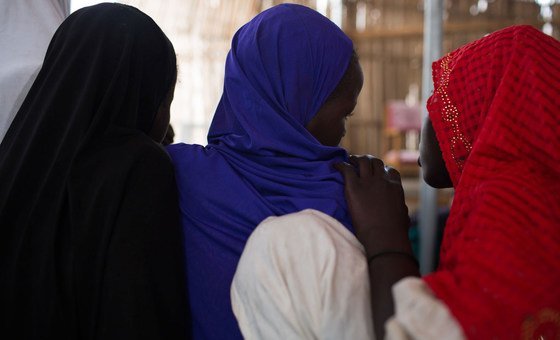
“They come and pick girls,” Ms. Wosornu, UNHCR Assistant High Commissioner for Protection, told journalists in Geneva on Friday, repeating what Mariam had told her in Nigeria. After escaping her ordeal which had involved attacks by multiple men, she “felt like she was taken out of a fire”, the UNHCR official added.
Last year, 171 UNHCR-supported “safe spaces” for women and girls were forced to close and today, 203 remain open.
When safe spaces shut, specialist services for survivors of attacks and abuse are cut and medical and legal referral options narrow, Ms. Wosornu explained.
The closures are part of a recent erosion of GBV services which left the agency’s programmes to counter the issue less than one-third funded in 2025. In all, 5.6 million forcibly displaced and stateless people have been left without lifesaving prevention and response services, according to UNHCR’s 2025 GBV Impact Report.
The development comes alongside this year’s 16 Days of Activism against Gender-Based Violence campaign, ending 10 December.
“Gender-based violence is one of the most pervasive human rights violations, hence the need for 16 Days (of Activism) and 16 days is certainly not enough,” Ms. Wosornu insisted. “Nearly one in three women globally has experienced some physical and sexual violence. More than 60 million forcibly displaced and stateless women and girls face heightened risks. So, these funding cuts are slashing the very services that are needed to support them. We must not mistake silence for safety.”
She recalled working in Goma, the Democratic Republic of the Congo, where survivors recounted their harrowing stories and asking them what they wanted most. “They said, ‘For our perpetrators to face justice.’ And yet, access to justice is one of the serious challenges that we face. Only nine per cent of survivors referred to legal services, due to documentation and language barriers.”
Barrier of stigma
It is often very difficult for many young women survivors to recover from their ordeals, especially since they can face rejection and stigma in their own families and communities. Today, though, Mariam and other survivors receive support and vocational training through a government-run initiative supported by UNHCR and partners.
Despite severe underfunding, the agency’s specialized GBV programmes reached 2.2 million people in 77 countries worldwide in 2025 and the first half of 2026.
This reflects the agency’s unique protection mandate, critical role and expertise in preventing GBV, identifying the specific risks faced by refugees, displaced and stateless people, and supporting survivors with access to registration, documentation, asylum, and the specialized care needed for recovery.
In all, 63 per cent of UNHCR operations reported delays in survivors accessing specialized GBV case management services due to staffing reductions among partners.
UNHCR-led analysis from Bangladesh, Jordan, Lebanon, South Sudan and Tanzania, compiled in the GBV Trends Report, showed that women and girls accounted for 98 per cent of recorded survivors, while nearly 88 per cent of incidents occurred in private residential settings.