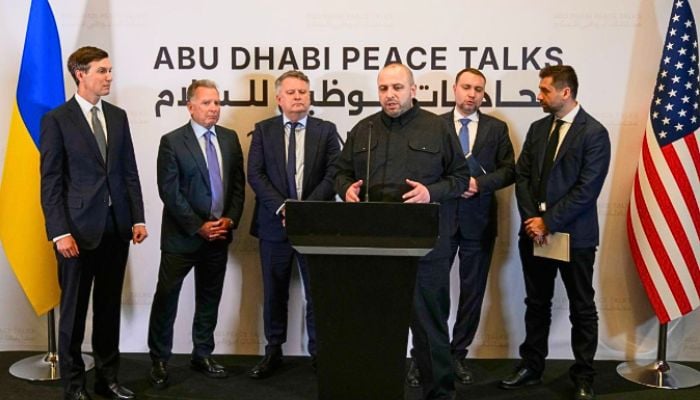
The recent U.S.-mediated peace talks in Abu Dhabi between Russia and Ukraine yielded a major humanitarian breakthrough an agreement in principle to orchestrate what is set to be the largest-ever prisoner exchange of the conflict.
US President Donald Trump’s envoy and son-in-law Jared Kushner said on Thursday Russia and Ukraine agreed to expand the next round of talks to include European nations as Washington works toward the war’s “largest prisoner exchange.”
The remarks came after Ukrainian President Volodymyr Zelenskiy welcomed news of European presence at the next round of the US-brokered peace talks, saying he hoped the agenda would include efforts towards ceasefires and defusing the conflict.
Key dimensions of this historic prisoner swap include:
Scope and Scale: U.S. and delegation officials noted that the exchange is expected to eclipse previous swaps, building on past tranches (which previously involved scaling up to roughly 1,000 captives from each side). Final numbers are being locked down to maximize the humanitarian release.
Building Trust Amid Impasses:
While broader geopolitical roadblocks—such as deep territorial disputes over the Donbas and southern regions, plus friction over Europe’s exclusion from current negotiation tracks—remain largely unresolved, both Moscow and Kyiv hailed the swap as a vital trust-building measure.
Next Diplomatic Horizons: U.S. special envoys including Jared Kushner and Steve Witkoff leveraged the momentum from the Abu Dhabi sessions to brief leadership directly in Moscow and coordinate subsequent steps with Ukrainian President Volodymyr Zelenskyy and European partners in Dublin.
“We are also working toward what would be the largest prisoner exchange of the war, potentially reuniting thousands of people with their families,” Kushner wrote on X, without giving details of the deal.
Expansion of the next round of talks with European partners would allow the tackling of “broader postwar European security arrangements alongside the territorial issues between Ukraine and Russia,” Kushner said.
Washington was encouraged by the progress made, he said, but added that significant differences remained.
Zelenskiy, speaking after talks with US envoys Steve Witkoff and Kushner, said it was important the process had resumed, following this week’s round of talks in Abu Dhabi that was the first in nine months.
Earlier Witkoff said Vladimir Putin agreed to let European representatives join the next round of talks, though the Russian president also urged Washington to urged Washington to work with European allies to understand if they wanted peace or war in Ukraine.
Kushner and Witkoff traveled to Moscow to meet Putin and to Dublin to meet Zelenskiy.
In his statement, Kushner said a lasting end to the fighting required credible security guarantees and “reciprocal” de-escalation commitments to reduce risk of future conflict.
Kyiv and Moscow said major differences remained despite some progress, particularly on territorial issues.
Russia holds a fifth of Ukraine and Kyiv refuses to give up the rest of its eastern region of Donbas.
Previously, Russia launched a full-scale invasion of Ukraine in February 2022. Trump, who vowed to end the war when he returned to the White House, is yet to reach a deal on that front.