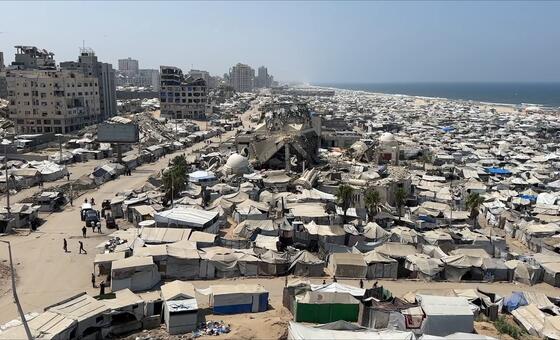
Speaking to UN News on the margins of the UN General Assembly High-Level Week, Mr. Alakbarov said UN agencies and humanitarian partners were working to address urgent needs including water, sanitation, shelter and healthcare, while also supporting efforts to remove debris, restore infrastructure and provide assistance to vulnerable communities.
Despite progress in delivering essential humanitarian assistance, significant obstacles remain, he said, including restrictions affecting humanitarian access and the entry of materials needed for reconstruction.
‘A return to normal life’
Mr. Alakbarov said the needs of people in Gaza extend beyond immediate humanitarian assistance, with communities seeking better living conditions and the opportunity to rebuild their lives.
He highlighted the importance of restoring water infrastructure and medical services, supporting education and creating opportunities for people to rebuild both homes and livelihoods.
Children sit inside a war-damaged building in Gaza City, where housing shortages and reconstruction delays leave families sheltering in structures at risk of collapse.
“One year after the ceasefire, while progress was made – on bringing such essential elements like food items, and nutrition – we still have not resolved a very cyclical matter related to water and sanitation, people don’t have access to clean water in sufficient quantities.”
UN agencies, including the UN relief agency for Palestine refugees (UNRWA), continue to operate on the ground, providing a range of services and assistance, despite “the restrictions which are imposed” he said.
For Gazans, the priority is increasingly a return to normal life, including adequate shelter, access to education and the ability to rebuild homes and livelihoods, according to the UN official.
“Gazans are tired, they want back to normal life, they are asking to not live another winter in tents. They need better housing; they would like to work.
“They are asking for their children to be able to go back to school. And they would like to actively contribute to the recovery of their land and to rebuilding Gaza.”
Concerns over West Bank
Mr. Alakbarov also addressed the situation in the occupied West Bank, where he said tensions were increasing amid settler violence, economic pressures and restrictions affecting Palestinian communities.
The developments add to wider humanitarian and political concerns, with the UN continuing to call for the protection of civilians and respect for international law.
The UN continues to provide assistance, through grants that help the families reestablish their livelihoods.
People walk down a dusty road in the West Bank carrying belongings.
Focus on political process
Turning to the broader political track, Mr. Alakbarov underscored continued international support for a two-State solution, with Israel and Palestine living side by side in peace and security.
He said renewed efforts were needed to rebuild trust, strengthen Palestinian institutions and create conditions for a credible political process.
The senior UN official’s comments come as the international community continues to grapple with the humanitarian consequences of the conflict, the challenges of recovery in Gaza and growing tensions in the West Bank.
The UN has repeatedly stressed that humanitarian assistance and recovery efforts need to be accompanied by progress towards a political settlement capable of addressing the underlying conflict.