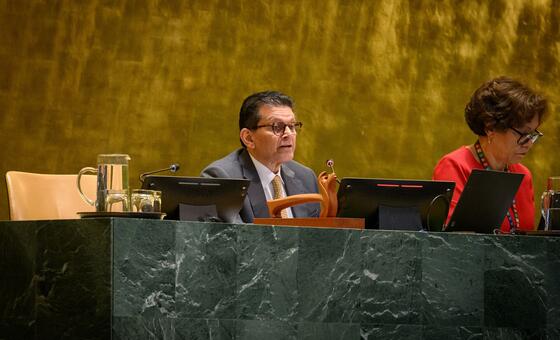
UN Crime Congress Deepens Global Cooperation on Emerging Criminal Threats.
ABU DHABI(News Desk):: The fifth day of the 15th United Nations Congress on Crime Prevention and Criminal Justice – Abu Dhabi 2026 brought together international experts and stakeholders to strengthen cooperation against organised crime, cybercrime, human trafficking and other emerging criminal threats, while advancing the responsible use of technology in criminal justice.
The day featured high-level discussions on international partnerships, capacity building, victims’ rights, digital governance and inclusive justice. Around 40 ancillary meetings examined a broad range of issues, including cross-border legal cooperation, financial crime, human trafficking, cyber scams, youth crime and safer cities.
Morning discussions continued under the Congress agenda on addressing and countering crime, including organised crime and terrorism. Workshop 4, “Turning the Digital Age into an Opportunity: Promoting the Responsible Use of Technologies in Crime Prevention and Criminal Justice,” examined ways to harness technological innovation while protecting human rights, privacy and public trust.
Afternoon sessions turned to strengthening international cooperation, technical assistance and training at national, regional and international levels. The day also saw the adoption of the report of Committee I, supporting progress towards the Congress’s thematic outcomes.
Future of Criminal Justice 2045
A key session organised by the UAE Public Prosecution explored the “Future of Criminal Justice 2045”, focusing on how artificial intelligence, digital technologies and algorithmic evidence are transforming justice systems.
The session examined the potential shift from reactive approaches to crime towards more proactive systems capable of identifying risks, while stressing that technological development must not compromise the presumption of innocence, the right to defence, legality, accountability or public trust.
The study does not seek to predict a single future. Instead, it develops multiple scenarios by analysing global trends, early indicators and potential disruptions.
The proposed “Prosecution of the Future” model is based on four pillars: a strong constitutional and legal foundation; advanced digital capabilities using data and artificial intelligence; ethical governance with explainable and reviewable algorithms and human oversight; and data and algorithmic sovereignty to protect judicial information and technological control.
Participants emphasised the principle that technology should strengthen justice while the law governs its use and human beings remain the ultimate decision-makers.
Strengthening International Partnerships
Discussions under the cooperation agenda focused on moving beyond dialogue towards practical mechanisms for capacity building and institutional development.
Participants highlighted the importance of aligning technical assistance and training with national priorities and strengthening partnerships among governments, international organisations, law enforcement and judicial authorities, academia, civil society and the private sector.
Ancillary meetings also addressed regional legal aid networks, electronic tools for international legal cooperation, and stronger cooperation to combat trafficking in cultural property.
Technology and Digital Justice
Workshop 4 examined the opportunities and challenges created by digital technologies in crime prevention and criminal justice.
Discussions covered digital governance, cybercrime prevention, civic-space protection, preventive justice and the potential use of artificial intelligence in witness statement-taking. Participants also considered technology-enabled organised crime, online drug trafficking and cyber threats affecting young people.
The programme further addressed non-consensual image sharing and the legal and social harms associated with such practices.
Smart Cities and Public Safety
A fireside chat titled “Smart Cities, Safe Cities: AI Infrastructure and Digital Systems for Public Safety” explored how artificial intelligence, secure digital infrastructure and integrated systems can contribute to safer and more resilient cities.
Participants discussed cybersecurity, data governance, digital twins, infrastructure modelling and the use of digital systems in emergency preparedness, crisis response and urban management.
They stressed that technology alone cannot guarantee safer cities, highlighting the importance of governance, institutional coordination, reliable data and safeguards for privacy and individual rights.
Victims’ Rights and Inclusive Justice
Victims’ rights remained a major focus on the fifth day, coinciding with the 40th anniversary of the United Nations Declaration of Basic Principles of Justice for Victims of Crime and Abuse of Power.
Sessions examined victims’ needs and services, access to justice, public defender institutions and the importance of incorporating the experiences of people affected by criminal justice systems into reform efforts.
Discussions also addressed labour exploitation and trafficking for forced labour, conflict-related sexual violence in the digital age, public trust in policing and people-centred approaches to justice.
Cyber Scam Centres and Human Trafficking
An INTERPOL-organised meeting examined the growing connection between cyber scam centres and human trafficking, focusing on international cooperation against criminal networks that exploit trafficked individuals to conduct cross-border digital fraud.
Other sessions explored links between climate-related disasters and human trafficking hotspots, the use of data to strengthen prevention systems while protecting victims’ dignity, and decentralised cooperation against trafficking.
Participants also discussed coordinated measures to protect older people from online scams through awareness, information exchange and stronger prevention and response mechanisms.
Organised and Financial Crime
The Congress also addressed illicit financial activity, suspicious financial flows and the role of financial intelligence units and other competent authorities.
Sessions examined measures to strengthen national efforts against corruption and organised crime, developments in transnational organised crime in the Pacific region and potential approaches for future peace operations.
Discussions on criminal justice reform also considered accountability and public trust, while sessions on alternatives to detention explored non-custodial measures and contemporary approaches to crime prevention and justice.
Youth, Communities and Safer Cities
The ancillary programme addressed youth mobilisation, local governance and civic education as tools for preventing crime and supporting inclusive justice.
Participants examined youth crime in the digital age, racist and hate crimes in sport, environmental design for safer cities and the role of women’s leadership in combating environmental crime.
Comparative analyses of regional and international crime trends were also presented, alongside civil society priorities for action following the Congress.
Building Criminal Justice Capacity
The UN Crime Prevention and Criminal Justice Programme Network (PNI) Lab held a session titled “From Training to Impact: The PNI’s Contribution to Strengthening Criminal Justice through Capacity-Building.”
The session highlighted capacity-building programmes developed by Programme Network Institutes and examined innovative approaches for measuring the long-term impact of training.
The 15th UN Congress on Crime Prevention and Criminal Justice will continue in Abu Dhabi until 1 October 2026. The Congress is bringing the international community together to strengthen cooperation under the framework of the Abu Dhabi Declaration, promote responsible technology use and support more effective, inclusive and future-ready criminal justice systems grounded in the rule of law.