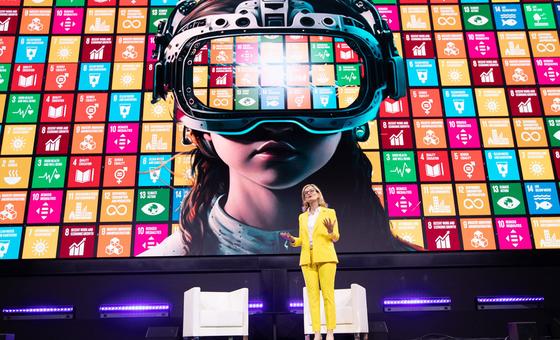
Across agencies, the UN is implementing AI tools to help promote peace, security and human rights while spearheading the global conversation around AI governance.
By the book
Six-year-old Ari in Jamaica has learning difficulties which make it difficult for him to study, but now AI technology is converting existing textbooks into interactive formats personalised to his needs.
“The real impact is what this means for children,” Pia Rebello Britto, UNICEF’s Global Director of Education and Adolescent Development, told UN News. “There are countless more examples like Ari’s, showing what becomes possible when digital learning is designed to reach every child.”
For UNICEF, implementing AI means putting the communities it supports at the centre of its technology development process.
The agency worked with advocacy groups to design its Accessible Digital Textbooks for All (ADT) initiative, which tackles a persistent barrier in global education: inaccessible learning materials for the nearly 240 million children worldwide living with disabilities.
While the programme existed before AI’s rapid rise, today’s AI-assisted version now operates in 17 countries, reaching nearly two million children, with a goal of expanding to 50 countries by 2030. Six countries have already joined this year.
Putting a brake on methane
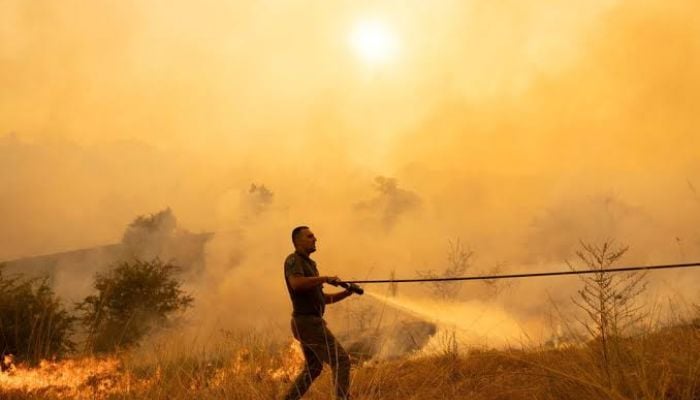
Methane is one of the gases that is contributing to global warming.
“Everybody – every person, citizen – anywhere in the world who is concerned about climate change must have an interest in slowing down global warming, and fixing methane leaks is the emergency brake,” said UNEP Climate Change Division Director Martin Krause.
Using satellite data to detect large methane leaks and notify governments and companies, the UN Environment Programme (UNEP) has helped prevent the equivalent of 24 million gas-powered cars worth of methane emissions since 2024.
That’s the year UNEP launched the Methane Alert and Response System (MARS), which uses AI to analyse data from 30 satellites to identify methane plumes.
Because AI is 12 to 15 times faster and more accurate than humans at detecting methane leaks, UNEP has issued 7,500 alerts, triggering 42 mitigation actions over the past two years, Mr. Krause said.
Companies often take prompt action to address these leaks, Mr. Krause said, because the alerts help them avoid product loss – a win-win for companies and the environment.
Not only is methane 80 times more potent than carbon dioxide in warming the atmosphere, but fixing methane leaks also reduces the proliferation of harmful smog, which can cause respiratory illness.
“This is not the UN building a task force and discussing a problem and having a meeting. This is real stuff,” Mr. Krause said. “This is happening as we speak.”
TB screening
With assistance from the UN’s World Health Organization (WHO), developing countries are using AI to analyse chest X-rays for signs of tuberculosis (TB), allowing faster screenings in areas with fewer specialists.
“It’s really helping people to move through the sort of diagnostic cascade onto treatment much sooner,” Dr. Vanessa Veronese, a scientist at the WHO’s Special Programme for Research and Training in Tropical Diseases, told UN News.
Earlier diagnosis also means fewer infectious people in the community, reducing onward transmission – a crucial step towards eliminating TB.
Dr. Veronese pointed to Ethiopia, where gold miners face an increased risk of contracting TB due to dust and silica exposure.
The technology behind early diagnosis is called computer-aided detection (CAD).
Chief among CAD’s benefits is that it generates a TB likelihood score very quickly, helping overstretched radiologists in low-resource settings, which is important because many die from TB if they do not receive treatment.
In 2021, the WHO officially recommended its use to screen for TB in adults and has since supported developing countries in adopting the technology. WHO provides practical implementation guidance, helps TB programmes calibrate the software and studies health outcomes.
Advancing crisis response
But as technology advances, the UN is emphasising equity, human rights and ethics to ensure AI promotes development instead of threatening peace and democracy.
Mr. Guterres has called AI “humanity’s greatest opportunity in the 21st century” and “one of its greatest risks,” stressing the need for inclusive oversight.
“We must ensure AI serves humanity, and not the other way around,” he said.