The conflict there killed hundreds of thousands of people, displaced millions, and caused severe damage to infrastructure across the country estimated at over $100 billion.
Joelle-Seme Park works for the UN Development Programme (UNDP) and recently travelled to Syria to visit recovery projects.
“Standing in the middle of a neighbourhood in Rural Damascus, it was hard to imagine what daily life here once looked like.
Piles of broken concrete and twisted metal block almost everything. Roads remain closed. Water and sewage networks cannot be repaired. Power and essential services struggle to return. Entire communities stay disconnected.
Joelle-Seme Park, a crisis readiness specialist with UNDP, meets a boy in Syria.
Streets are blocked by rubble. Buildings have collapsed. Shops are shuttered.
Even moving from one street to another is difficult.
One thing became clear to me; until rubble is removed, life cannot fully restart.
Communities are driving efforts to clear rubble, yet they cannot do it alone.
Clearing debris requires equipment, planning, coordination and sustained support.
Through the REVIVE project, UNDP and its partners are helping communities take those first steps forward.
The project is clearing 570,000 tonnes of debris across Aleppo, Deir-ez-Zor, Homs and Rural Damascus, while rehabilitating roads, water and sewage networks, providing explosive ordnance risk education and supporting debris recycling initiatives that turn rubble into construction materials.
Rebuilding communities and lives
Across the communities I visited, the pattern was consistent; once rubble is removed, life begins to return.
Movement resumes. Access is restored. Families begin coming home.
This work also provides something many families urgently need: a source of income.
So far, more than 1,300 people have participated in cash-for-work activities linked to debris removal, helping support over 6,000 family members.
One woman I spoke to who was working at a debris recycling facility in Aleppo told me how that before the project she had no income to support her family, but that now she can provide food and medicine for her children, niece and nephew. She also said they are now back in school.
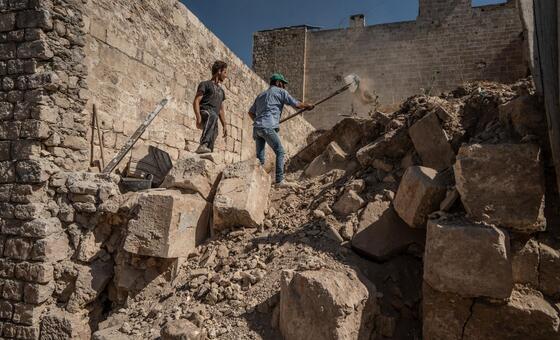
The UN Development Programme is supporting debris removal in Syria.
Beyond the income, there is also pride in helping restore a neighbourhood. In reopening a street. In seeing visible progress where so much has been disrupted.
A community volunteer I met in Aleppo said that after the debris removal, local people volunteered to rebuild a park and streetlights, allowing children and women to enjoy this space after school, without fear and in peace.
What stood out most to me was not only the scale of the work, but the determination of communities themselves, with people removing debris from their homes with their bare hands.
In Syria, clearing debris is not only about removing what was destroyed. It is about reopening roads, reconnecting services, supporting livelihoods and helping communities regain a sense of normal life again.”