Aid agencies are doing what they can to help, including by identifying dangerously malnourished children in sparsely populated “ghost villages” where those who can leave do so, said Olga Cherevko from the UN aid coordination office, OCHA.
But with nearly 22 million people in need across Afghanistan and the UN’s $1.7 billion appeal only 14 per cent funded, life is “becoming impossible” in remote areas, the agency warns.
Survival strategy
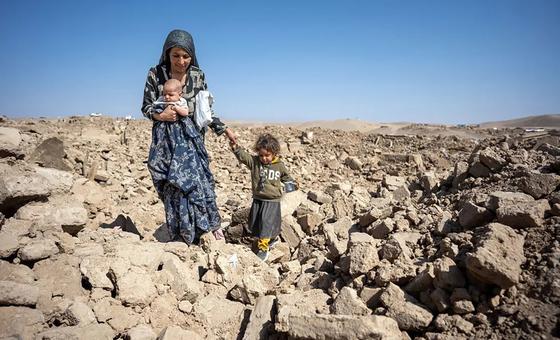
Water scarcity is the main cause of strife for villagers in Bamyan province who struggle, far from Afghanistan’s major cities.
“This particular village that I went to, they told me that around half of the population had left, actually, because there’s simply no water to irrigate the lands, and so all the crops that they were growing, they dried up,” Ms. Cherevko told UN News. “People who could leave, they left.”
Those who have remained often do so because they have no choice; they cannot afford to leave.
Ms. Cherevko shared a striking example: “One of the men that I met had nine family members. He showed me what they were having for lunch. It was essentially a bowl of what looked like rotten potato peelings, cooked into a soup just to survive.”
3.7 million children facing acute malnutrition in 2026
Today, an estimated 3.7 million children in Afghanistan suffer from acute malnutrition. Many cases go unrecognized and in some UN-supported clinics “children die because parents simply didn’t know what was happening; by the time they brought the child in, it was already too late”, Ms. Cherevko explained.
The UN is addressing this critical issue by providing screening and medical support, but also by visiting remote communities and raising awareness.
Afghan women with their families arrive from Pakistan with their belongings at the Torkham crossing point (August 2025)
Forced returnees’ plight
Agencies also provide basic assistance and registration every day to thousands of people who are often forcibly returned to the country by its neighbours.
According to the UN refugee agency, UNHCR, around 8,000 people returned to Afghanistan in the week to 20 June 2026.
Most of these returnees have never lived in Afghanistan and did not choose to return. Their biggest concern is survival in a land of few opportunities.
“Once the buses drop them in towns, many have nowhere to go,” Ms. Cherevko explained. Some attempt to return to the countries they came from, only to be deported again. Despite this, many continue trying to leave Afghanistan, driven by desperation and a lack of alternatives.
Alarming situation for women and girls
With Bamyan province fresh in her mind, Ms. Cherevko highlighted a recurring message from the Afghan women she visited: when opportunities for women are limited, the entire household suffers. Restrictions on education for girls decreed by the Taliban are denying them future employment. “All the women I spoke to are deeply worried about their daughters, who can no longer attend school and may have no future,” the OCHA worker said.
These restrictions are affecting the work of the UN and essential services in turn.
A shortage of female professionals, particularly doctors, has become critical, for instance. Now, when a female doctor leaves her position, it is often nearly impossible to replace her. This has limited women’s and girls’ access to life-saving healthcare drastically, including maternal and neonatal care, as well as services for malnutrition and education.
From January to April 2026, aid partners reached 5.9 million people in Afghanistan with at least one form of assistance. Of this number, 3.5 million received food assistance, underscoring the scale of acute food insecurity and the many other needs of millions of people “who require repeated and complementary support throughout the year to ensure their needs are adequately met”, OCHA said.