In the Al-Mawasi area west of Khan Younis, where tents stretch across the sand and snaking queues form for water and food, Asaad Al-Azzabi prepares for a match a world away from what he once knew.
Before the war, Mr. Al-Azzabi played for Al-Tajammu Club in Rafah, where he and his teammates had access to pitches, training halls, coaches and equipment.
Asaad Al-Azzabi’s torn boots.
Borrowed boots
Now, he’s lucky if he can find boots to play in. “Sometimes I borrow a pair from a friend or patch them up with tape,” he says.
His home is now a tent in Al-Rahma Camp, a shelter for people displaced from Rafah, where access to clean water and sanitation services is scarce. He lives alone, after his wife left for Jordan with their son, who has cancer, to seek treatment.
According to UN data, around 1.7 million people are living in around 1,600 displacement sites across the Gaza Strip, most of them in temporary or informal locations. Most residents rely on water brought in by truck and are forced to cope with restrictions on the entry of equipment, fuel and repair materials.
Amid the struggle to meet basic needs, Mr. Al-Azzabi is preparing for the match with nearby Sheikh Al-Eid Camp. He explains the game plan to his players by drawing on the sand, before the team sets off on foot toward a pitch located among the tents of displaced people.
The match appears to be more than a sporting activity – it is a respite from the daily hardships of life in the camps.
Children and young men gather around the sandy pitch, applauding players, some of whom arrived after spending hours standing in queues for food, water or battery charging.
Displaced people from Rafah watching the match between Al-Rahma Camp and Sheikh Al-Eid Camp.
Something out of nothing
Referee Alaa Abu Taha, a referee with the Palestinian Football Association and a displaced resident of Rafah, says football has become the “only outlet” for many people in Gaza.
“With the most limited resources, we try to play. Now there is no sports infrastructure. The pitch we are standing on now was originally prepared for basketball and volleyball, but our people create everything out of nothing,” he says.
Gaza’s sports sector has suffered widespread destruction since the outbreak of the war. According to the Palestinian Football Association, hundreds of athletes have been killed, including many footballers, while hundreds of sports facilities have been damaged or destroyed, including pitches, club headquarters and training halls.
In Al-Mawasi these losses have not prevented players from organising a championship between displacement camps.
The big match
The match kicks off in front of a small crowd of displaced spectators, with Mr. Al-Azzabi taking part in boots held together by plastic tape. At the end of the match, Al-Rahma Camp defeats Sheikh Al-Eid Camp 2–1.
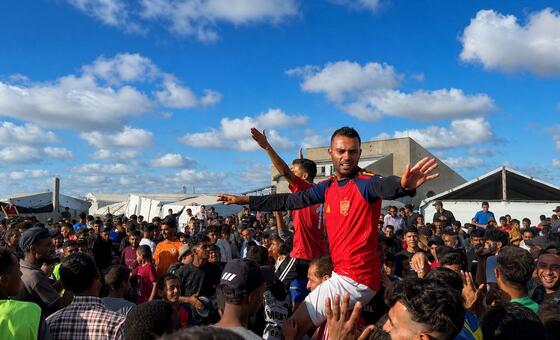
Asaad Al-Azzabi celebrating with the crowd of young men and children.
After the final whistle, young men from the camp lift him and his teammates onto their shoulders, while children and young people celebrate among the tents. For a few brief moments, the sound of displacement recedes from the scene, and football emerges as a rare space for joy.
“Under these difficult circumstances, to be able to come out and play a match like this is a very good thing,” says Mr. Al-Azzabi. “Congratulations to our camp. I dedicate this championship to my wife and son in Jordan, and I wish my son a speedy recovery.”
For him, the game is more than a sporting victory. It is a message to his distant family and an attempt to preserve what remains of his life as a former player, chasing the ball as if it were the last thing connecting him to who he was before the war.