In an alert, the UN World Health Organization, WHO, warned that Cuban hospitals have been struggling to maintain emergency and intensive care services.
“Thousands of surgeries have been postponed during the last month and people needing care…have been put at risk” from the lack of available power for medical equipment, said WHO Director-General, Tedros Adhanom Ghebreyesus.
Healthcare must be protected
He insisted that “health should be protected at all costs and never be at the mercies of geopolitics, energy blockades and power outages”.
This latest crisis for Cuba follows Hurricane Melissa last October, which affected more than 2.2 million people across the island nation.
UN aid coordination office, OCHA, has launched a revised $94 million Plan of Action to address the worsening humanitarian impact of severe fuel shortages.
Since January, reduced fuel imports have disrupted essential services. The updated plan aims to support two million people – around one in five Cubans – and now covers nearly half the country. So far, $26 million has been secured, leaving a funding gap of $68 million.
The response prioritises maintaining essential services and sustaining life-saving supply chains, with a focus on health, water, food security and education, alongside alternative energy solutions. Access to fuel remains critical for implementation.
Haiti’s ‘vortex of violence’ now at disastrous levels
The Human Rights Council on Thursday examined the spiralling crisis in Haiti, as gangs starve and extort the Caribbean island’s people, according to the UN.
Data from the UN human rights office, OHCHR, shows that at least 5,500 people were killed and 2,600 injured in gang-related violence between 1 March 2025 and 15 January 2026.
In an update, the Council heard that 65 per cent of these casualties happened during operations by security forces against gang members. More than one in five victims – including children – were struck by stray bullets in their homes or on the street.
Latest indications are that gangs control most of the capital, Port-au-Prince, and they are expanding into its outskirts and moving north, into the Artibonite and Centre departments.
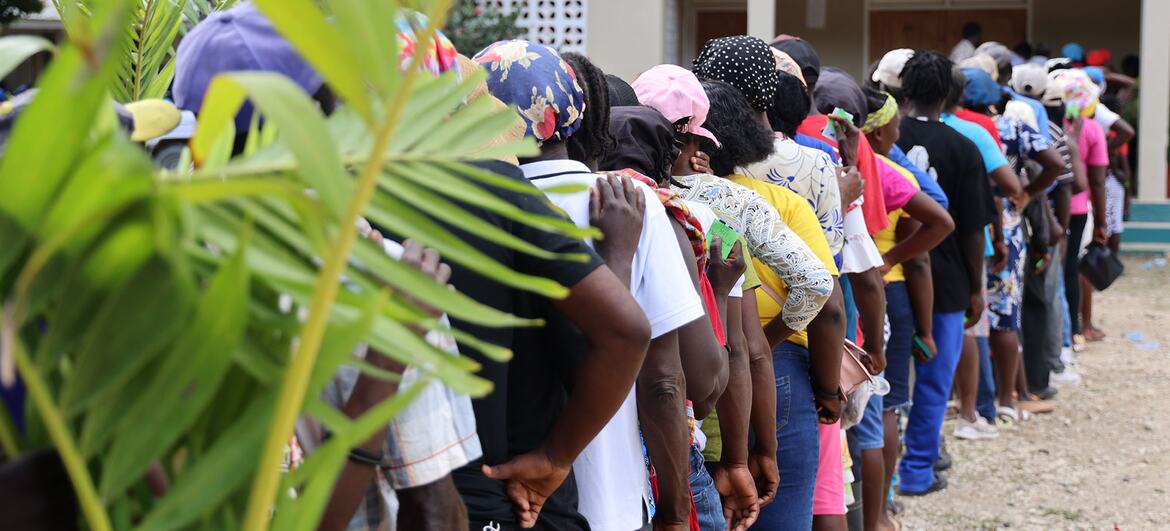
People displaced by violence in Haiti wait in line at an aid distribution site.
Weapons-fuelled disaster
The emergency is “fuelled by weapons”, said Deputy High Commissioner, Ms. Al-Nashif, who described a “vortex of violence” and urged all governments to implement the Security Council’s arms embargo in full and stop firearms and ammunition reaching Haiti.
Gangs “kill, kidnap, beat and burn the bodies of anyone who gets in their way. This includes people who resist extortion and those they perceived as collaborating with the police,” Ms. Al-Nashif said.
She highlighted disturbing evidence that gangs coerce children into committing targeted killings, sexual violence and kidnapping, as well as monitoring security forces and collecting extortion payments.
The violence has internally displaced more than one million people; thousands more have been displaced in recent weeks.
Deadly Djibouti shipwreck leaves dozens missing
At least nine migrants have died and 45 remain missing after a boat capsized off the coast of Djibouti, the UN migration agency, IOM, reported on Thursday.
The vessel, believed to have been carrying more than 300 people, sank on 24 March as it attempted to cross the Bab el-Mandeb Strait towards Yemen. Survivors said many on board were Ethiopian nationals seeking better opportunities in Gulf countries.
“Every life lost at sea is one too many,” said Tanja Pacifico, IOM Chief of Mission in Djibouti, warning that the tragedy could be “the first of many incidents this year” as harsher seasonal winds and rough seas set in.
So far, the bodies of six men and three women have been recovered, while more than 120 survivors are receiving assistance at a migrant response centre in Obock. Support includes food, shelter, healthcare and psychosocial services.
Search and rescue operations led by Djibouti authorities are ongoing.
Refugees and migrants, essential contributors’
UN health agency WHO on Thursday published a new report highlighting that refugees and migrants are more than just recipients of care, “they are essential contributors to our health systems and our societies.”
WHO added that when their health and inclusion is supported by host societies, we can all build stronger, fairer and more resilient communities. Find out more here.